PART 6
This time, I hoped he did.
The next month was difficult for them.
They found a smaller rental home farther from the neighborhood where Madison’s parents lived. They sold some furniture, canceled unnecessary subscriptions, and reconsidered the investment company.
Trent took on additional work and began paying down the debts he had accumulated while trying to maintain an image he couldn’t afford.
Madison returned to a job she had left when they moved into Brentwood, giving them a second income.
They weren’t suddenly wealthy.
They weren’t suddenly successful.
They were simply learning to live within their means.
And, for the first time in years, they were building their lives on numbers that were real.
When they moved out, I visited the house with a contractor to inspect the property.
The walls were intact. The plumbing worked. The lawn needed attention, and one section of fencing required repair.
There were no dramatic discoveries waiting behind the walls.
Just an ordinary house that needed ordinary maintenance.
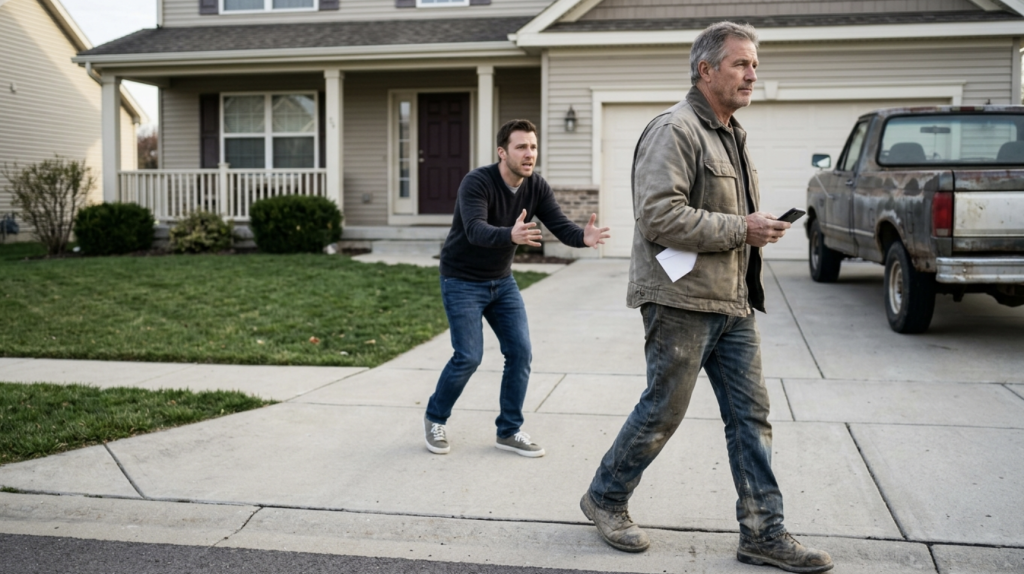
I walked through the living room where I had once stood outside, listening to my son pretend that the home belonged to him.
Then I stepped onto the porch.
The same porch.
The same front door.
The same place where he had looked at my work jacket and decided I was an embarrassment.
I didn’t feel triumphant.
I felt sad.
Because the property had never been the most valuable thing I owned.
My relationship with my son had been worth far more.
And for a while, I had allowed my generosity to become a substitute for the honest conversations we should have had years earlier.
I could not change what had happened.
But I could decide what happened next.
I hired a property manager, put the house on the rental market under a proper written agreement, and began setting aside a portion of the income for repairs.
I had no intention of selling it out of anger.
It was an investment, and I would treat it like one.
As for Trent, I left the door open to rebuilding our relationship.
Not the front door of Brentwood.
The door that mattered.
The one between a father and his son.
That door would take longer to repair.
And this time, I knew better than to pretend a fresh coat of paint would be enough.
Three months after Trent moved out, he showed up at my house on a Saturday morning.
He wore an ordinary sweatshirt and jeans. No expensive watch. No confident smile pretending everything was perfect.
In his hands was a small envelope.
“Dad,” he said, “I owe you this.”
Inside was a handwritten letter and a check covering the first portion of the money he had saved since moving out.
“I know I can never repay five years of your generosity,” he said. “But I want to start doing things differently.”
I looked at the check, then at my son.
“What made you change?”
He lowered his eyes.
“The day you stood outside that house, I thought you were embarrassing me. But when I had to move out, I realized I wasn’t embarrassed by your clothes. I was embarrassed because you reminded me of everything I’d pretended to achieve on my own.”
His voice cracked.
“You worked your whole life to give me opportunities, Dad. And I used your kindness to impress people who didn’t even know the real me.”
For a moment, neither of us spoke.
Then he added, “I’m sorry I made you feel like you weren’t good enough to enter a house you paid for.”
I felt the weight of those words settle between us.
Finally, I pushed the check back toward him.
“Keep it. Pay your bills, build your savings, and take care of your family. I didn’t help you all those years because I expected repayment.”
He looked confused.
“Then what do you want from me?”
“Honesty, Trent. Even when the truth makes you look ordinary.”
Tears filled his eyes.
Then, for the first time in a long while, my son hugged me without asking me for anything.
Over the following months, we slowly rebuilt our relationship. He began visiting regularly, sometimes bringing Madison, sometimes coming alone. We talked about work, money, and the mistakes we had both made. Trust returned gradually, through actions rather than promises.
I never transferred the Brentwood house to him. I kept it as my investment, and Trent eventually saved enough to purchase a modest home of his own.
The day he invited me to see it, he met me outside wearing work boots covered in mud.
He grinned.
“Come inside, Dad. I want everyone to meet the man who taught me how to build a home.”
This time, there were no excuses, no closed doors, and no one checking my clothes.
I stepped inside.
The house was smaller than Brentwood, the furniture was simple, and the walls still needed painting.
But when I looked at my son standing beside his wife, I saw something I hadn’t seen in years.
Pride—not in what he owned, but in what he had honestly earned.
And I finally understood something important: the greatest gift a father can give his son isn’t a house, money, or a head start in life. It’s the chance to learn that his worth doesn’t depend on pretending to be someone he’s not.
I had given Trent a house for five years.
But losing it had finally taught him how to build a home.
The End.