PART 3
I’d imagined that he considered me nothing more than another person occupying space in his house.
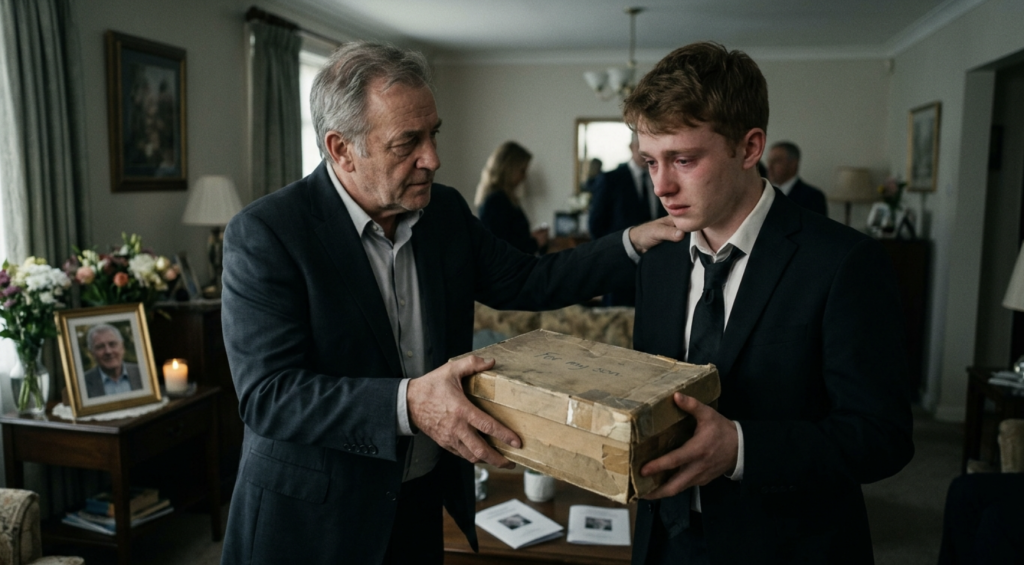
Now, sitting in the chair where he used to drink his coffee every morning, I stared at those envelopes and wondered whether I’d ever truly known the man who raised me.
“What is this?” I whispered.
Marcus pulled a chair beside mine.
“Open the first envelope.”
I looked at him suspiciously.
“Did you know about these?”
“I knew your father had been preparing something for you. I didn’t know exactly what he put in the box.”
“How long have you known?”
Marcus rubbed his hands together, his expression troubled.
“Longer than I’d like to admit.”
That answer irritated me.
“Then why didn’t you tell me? You were his best friend. You watched him treat me like a tenant for five years. You watched me struggle to pay him rent while I could barely afford groceries.”
Marcus lowered his eyes.
“Because your father made me promise that I wouldn’t interfere unless I believed you were in danger.”
I laughed bitterly.
“Danger? I was eighteen years old, Marcus. I was working thirty hours a week while finishing school. I wore shoes with holes in them. I ate instant noodles for dinner because I couldn’t afford anything else. What exactly did you think was going to happen to me?”
He didn’t defend himself.
That somehow made me angrier.
I picked up the first envelope and tore it open.
Inside was a bank statement, a folded piece of paper, and a receipt.
The bank statement showed a deposit of $250.
The date matched the first month I’d paid my father rent.
The next statement showed another $250 deposit.
Then another.
And another.
I flipped through the papers, my confusion growing.
Every month, the same amount had been deposited into an account.
The account holder’s name wasn’t my father’s.
It was mine.
I stared at it until the letters blurred.
“What am I looking at?”
Marcus leaned closer.
“Keep reading.”
I unfolded the handwritten note.
It was short.
Son,
You probably think I took this money because you turned eighteen and I decided you were old enough to pay your own way.
Maybe that’s exactly what I wanted you to think.
I have my reasons, and I know you may hate me for them. You have every right to feel whatever you feel.
But there is something I need you to understand.
Every dollar you gave me went somewhere. Not one dollar was spent on beer, fishing gear, or anything for myself.
When you’re ready, open the next envelope.
Dad.
I read it twice.
Then a third time.
My first reaction wasn’t relief.
It was anger.
“What kind of person does this?” I demanded. “Why wouldn’t he just tell me?”
Marcus remained quiet.
“He let me believe he didn’t care about me! He watched me struggle. He watched me repair my shoes with glue. He watched me work every weekend while my friends were going to college.”
My voice cracked.
“And now I’m supposed to believe he was secretly doing something good?”
Marcus looked at me.
“No. You’re supposed to find out what he actually did. Whether you forgive him is a different question.”
That stopped me.
For the first time that evening, I looked at Marcus without seeing him as an accomplice to my father’s silence.
He was an old man who had lost his closest friend.
And I was a son who had spent five years believing his father didn’t love him.
Neither of us knew what to do with the truth sitting between us.
I wiped my face and reached for the second envelope.
Inside was another bank statement, another receipt, and a longer letter.
Son,
The first year you paid rent, you wanted to move out so badly that you started looking at apartments.
I remember hearing you on the phone with your friend, talking about how you couldn’t wait to get away from me.
I stood in the hallway and listened.
I wanted to walk into your room and tell you that you didn’t have to leave. I wanted to tell you that the house would always be yours.
But I didn’t.
I told myself that you needed to learn how to stand on your own two feet.
The truth is, I was afraid.
Your mother always believed you could become something special. She wanted you to have choices I never had. She wanted you to be able to leave a bad situation without having to beg someone for help.
After she died, I didn’t know how to give you that future.
I knew how to work. I knew how to pay bills. I knew how to keep the roof from leaking and the lights from going out.
But I didn’t know how to talk to a boy who missed his mother.
So I did what I knew how to do. I worked more hours. I bought groceries. I kept the house standing.
And when you needed a father who would sit beside you and listen, I gave you a lecture about responsibility instead.
I’m sorry.
I stopped reading.
Those two words were so simple that they seemed almost insulting.
Five years of silence.
Five years of resentment.
Five years of believing that I was nothing more than a financial burden.
And all he had left me was a piece of paper saying he was sorry.
I crumpled the letter in my fist.
“That’s it?” I asked. “He writes a few words after he’s dead, and I’m supposed to feel better?”
Marcus shook his head.
“No, son. There is no letter in that box that can give you back the years you lost.”
I looked down at the paper.
For some reason, that answer hurt more than any excuse could have.
Marcus continued.
“But I think he wanted you to know why he did what he did. He just never understood that knowing why doesn’t make the hurt disappear.”
I slowly unfolded the crumpled letter.
I couldn’t throw it away.
Not yet.
I opened the third envelope.
This time, the documents were different.
There was a printed email from a community college, a tuition estimate, and a brochure for an electrical technology program.
I frowned.
I’d considered going to college after high school. I had even applied to a technical program, hoping to learn a trade that would give me a better future.
But I never enrolled.
I couldn’t afford the tuition and rent, and I refused to ask my father for help.
I remembered telling him about the acceptance email one evening.
He’d been sitting at the kitchen table, cleaning mud from his fishing boots.
“I got accepted into the program,” I’d said.
He hadn’t even looked up.
“Good.”
“Tuition is more than I expected.”
“Then you should have thought about that before applying.”
I’d gone upstairs and shut my bedroom door.
A week later, I’d declined the offer.
Now I was staring at the same tuition estimate.
Someone had circled the total cost in blue ink.
Underneath it, my father had written a sentence.
He should never have had to give this up.
My stomach tightened.
I turned to Marcus.
“Did he know I turned down the program?”
“Yes.”
“How?”
“He called the college.”
I stared at him.
“He what?”
Marcus sighed.
“Your father found the acceptance letter in the recycling bin. He called the admissions office to ask whether there was any way to reopen your application. They told him you would have to apply again, but they also explained the tuition and financial aid options.”
I could barely speak.
“Then why didn’t he tell me?”
“Because by then, he had convinced himself that if he helped you directly, you’d never learn to manage your own life.”
I stood up so abruptly that the chair scraped across the floor.
“That’s not teaching someone responsibility! That’s just being cruel!”
“I know.”
“He could have paid for the program. He could have helped me apply for financial aid. He could have said one decent thing to me!”
“I know.”
“Stop saying you know!”
My shout echoed through the kitchen.
Marcus flinched.
I immediately regretted it, but the anger was too big to swallow.
I paced toward the window, looking out at the driveway where my father’s truck still sat.
He had driven that truck to work for almost twenty years. He had driven it to the grocery store, to the hardware shop, and to the lake where he spent most of his weekends.
I used to hate that truck.
Every time he drove away with his fishing gear, I wondered why he could find time for a lake but never for me.
Now I wondered how many secrets he had carried inside it.
I turned back to the table.
“What did he do with the money?”
Marcus gestured toward the envelopes.
“Open them all.”
I returned to my chair.
The fourth envelope contained more statements, a certificate from a bank, and a letter with a date from two years earlier.
The account balance was much larger than I’d expected.
My rent payments had been deposited every month. The account had also earned interest, and there were no withdrawals.
But there was something else.
A document showed that my father had arranged for the money to be held in a savings account intended to help with education and housing expenses.
The beneficiary was me.
My hands began to tremble again.
“How much is in here?”
Marcus pointed to the final statement.
I read the balance.
Then I read it again.
Nearly seventeen thousand dollars.
Fifteen thousand from the rent I’d paid over five years, plus accumulated interest.
It wasn’t a fortune.
But it was more money than I’d ever had in one place.
Enough to pay for a substantial part of a college program.
Enough to replace my old car.
Enough to put a deposit on a small apartment and finally leave the house I’d spent years wanting to escape.
My father had been collecting my rent and saving it for me.
The knowledge left me feeling strangely hollow.
I had wanted proof that he cared.
Now I had proof that he had tried, in his own deeply flawed way.
But the proof couldn’t erase the nights I’d cried alone in my bedroom, or the birthdays he’d forgotten, or the times I’d wished I had a father who would simply ask whether I was okay.
I looked at Marcus.
“Was this his idea of love?”
Marcus was quiet for a long moment.
“I think he loved you,” he said finally. “But loving someone and knowing how to love them are not the same thing.”
I looked away.
That was the first answer that made sense.
Then I noticed the fifth envelope.
It was smaller than the others.
There was no bank statement inside, no receipt, and no financial document.
Just a letter.
The handwriting looked shakier than before.
I opened it carefully.
My boy,
If you’re reading this, I’m no longer there to explain myself.
I need to tell you something I should have told you years ago.
The money in that account was never meant to buy your forgiveness. You don’t owe me forgiveness because I saved it.
I was your father when I asked you to pay rent, and I was your father when I let you believe I didn’t care.
I made those choices. I cannot ask you to pretend they didn’t hurt.
But I need you to know that every month when you handed me that money, I wanted to tell you to keep it.
Every month, I wanted to tell you that you were still my little boy, even if you were old enough to work and drive and sign your own papers.
I never said it.
And that is the part I regret most.
Your mother used to tell me that boys remember the little things their fathers do. The promises kept. The games attended. The conversations at the kitchen table.
She was right.
I thought providing for you was enough. I thought if you had food, shelter, and a job, you would understand that I loved you.
I forgot that children cannot read minds.
I forgot that sons need to hear the words.
I forgot that you were still growing up, even after you turned eighteen.
I am sorry I made you feel alone in a house that should have been your home.
I am sorry I let you think you had to earn your place in my life.
You never did.
I couldn’t see the rest of the letter.
My tears had fallen onto the paper, blurring the ink.
For five years, I’d wanted my father to admit that he’d been wrong.
Now he had.
But he wasn’t sitting across from me.
He wasn’t looking me in the eyes.
He wasn’t going to put a hand on my shoulder or ask me to forgive him.
I had received the apology I’d wanted from a man who could never hear my answer.
I folded the letter carefully and placed it on the table.
Then I opened the small leather notebook.
The first pages contained ordinary entries.
Dates.
Amounts.
Notes about bills and household repairs.
But halfway through the notebook, the entries changed.
They were no longer about money.
They were about me.
March 14: He came home late from work. Looked exhausted. I asked if he’d eaten. He said yes, but I saw the empty refrigerator shelf. I should have asked him to sit down and made him something.
April 2: His shoes are falling apart. I offered to buy him a new pair, but I told him I was doing it because his old ones were embarrassing. He refused. I shouldn’t have said that.
June 19: He passed his driving test. I heard him telling Marcus on the phone. I wanted to congratulate him, but he had already gone to bed.
August 7: He came home with a college brochure. I pretended not to notice. I am proud of him. I need to tell him.
I pressed my hand against my mouth.
The entries continued.
Some were short.
Others filled entire pages.
My father had written about the times he’d heard me laughing with friends and stood quietly in the hallway because he didn’t know how to join the conversation.
He had written about finding my mother’s old photographs and wondering whether I remembered her voice.
He had written about the way I used to fall asleep on the couch when I was little, waiting for him to return from work.
And he had written about the night I turned eighteen.
Today, I asked him to pay rent.
He looked at me as though I had betrayed him.
I wanted to explain that I was putting the money away for his future. Instead, I told him he was an adult.
He went to his room without finishing dinner.
I stood outside his door for ten minutes.
I wanted to knock.
I didn’t.
I shut the notebook.
I couldn’t read another word.
Marcus reached across the table and placed his hand over mine.
“I’m sorry,” he whispered.
I looked at the box again.
There was one thing I still hadn’t examined.
The small set of keys.
THE NEXT PART 4 👇