PART 3
Veronica’s face turned red.
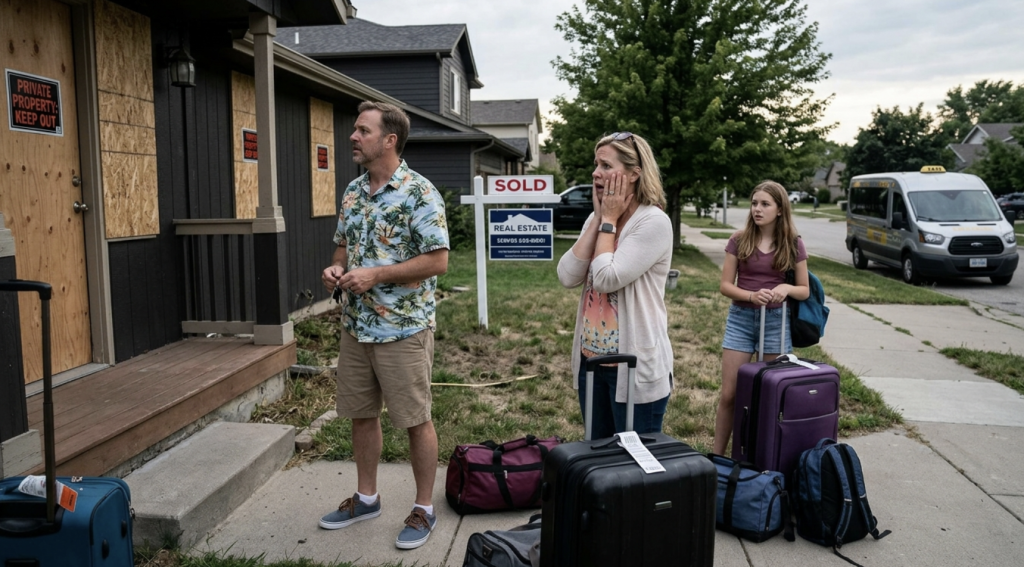
“Don’t play games with me! We came home, and all our stuff is at Mom and Dad’s house! The locks have been changed! There are strangers’ cars outside the apartment! What the hell is wrong with you?”
“Nothing is wrong with me.”
“You can’t just throw us out!”
I almost smiled at that.
Not because anything was funny, but because I had spent years believing Veronica was simply immature. Standing there, listening to her accuse me of cruelty while she wore the same bracelet I had bought her for her last birthday, I finally understood that immaturity had never been the real problem.
She had grown accustomed to a world where consequences belonged to other people.
“That’s interesting,” I said. “You had no trouble throwing me away when I asked you to help bury my son.”
My mother stepped forward.
“Angela, this is not the time for your emotional games.”
I stared at her.
“My emotional games?”
“Yes. We understand you’re grieving, but you cannot punish an entire family because we took a vacation that had already been paid for.”
I felt something cold settle in my chest.
“An entire family?”
I looked directly at her.
“Mom, I called you from the hospital after Matthew died. I was alone in a hallway where I had just learned that my only child would never open his eyes again. I asked you to help me arrange his funeral.”
Her lips tightened.
“And you told me you couldn’t lose eight thousand dollars.”
“That is not exactly what I said.”
“It is exactly what you said.”
My father finally put his phone in his pocket.
“Angela, your mother was under stress. We all were. Nobody knew what to say.”
“You knew what to do.”
He frowned.
“What does that mean?”
“It means you could have come to the hospital. You could have helped me choose a casket. You could have stood beside me when I buried my child. You could have called to ask whether I had eaten, whether I needed someone to stay with me, whether I was surviving the night.”
My voice cracked on the last sentence, and I hated that they could still reach that part of me.
“But you didn’t. You went to Cancun.”
Ruben shifted uncomfortably.
“Look, Angela, we’re sorry about Matthew. Everyone knows that was terrible. But this apartment situation is different. We have a lease arrangement with you, right?”
“No.”
His eyebrows rose.
“What do you mean, no?”
“I mean you never signed a lease. Jack and I allowed you to stay there because you said you needed time to save money. We paid the expenses, handled the repairs, and never asked you for rent.”
“That’s not how it was supposed to work,” Ruben protested.
“How was it supposed to work, Ruben? You were going to live there for five years, then perhaps ten, then leave it to your children someday?”
Veronica stepped between us.
“Jack would never have done this!”
His name struck me like a hand across my face.
For a moment, I could see him so clearly that I almost expected him to appear behind her, wearing his old plaid shirt, shaking his head at the ridiculous scene.
Jack would have hated this confrontation.
He would have wanted everyone to sit down, calm down, and talk.
He would have reminded me that family was worth fighting for.
But Jack was gone.
Matthew was gone.
And the people who had benefited most from my husband’s kindness were now using his memory as a weapon against me.
“Don’t tell me what Jack would have done,” I said.
Veronica blinked.
“He loved us.”
“He helped you. There is a difference.”
“You’re being cruel!”
“No. Cruel was telling a grieving mother that her child’s death was her problem. Cruel was posting vacation pictures while his grave was still fresh. Cruel was smiling for photographs beneath a caption about how your family always shows up for you.”
Her expression changed.
For the first time, she looked as though she understood exactly which photographs I meant.
“You saw those?”
“I saw every one of them.”
Mom turned toward Veronica.
“What pictures?”
Veronica looked away.
Ruben rubbed the back of his neck.
My father muttered something under his breath.
I stepped aside from the doorway, not to invite them in, but to make the boundary between us unmistakable.
“You have your belongings. You have a place to sleep at Mom and Dad’s house. Nobody has destroyed anything, and nobody has stolen from you. The apartment belongs to me, and I have decided that I will no longer provide it for free.”
Veronica stared at me.
“You can’t do this to us.”
“I already did.”
Then I closed the door.
I heard her pound on it twice.
“ANGELA!”
I stood on the other side, trembling.
Not from fear.
From the effort it took not to collapse.
I walked to Matthew’s bedroom, sat on the edge of his bed, and pressed his baseball glove against my chest.
“I’m trying, sweetheart,” I whispered. “I’m trying to be the person I need to be now.”
For the first time since the funeral, I cried until I could barely breathe.
But I did not open the door again.
The following morning, my phone contained thirty-seven missed calls.
Twelve from Veronica.
Nine from my mother.
Six from my father.
Five from Ruben.
The rest came from relatives who had apparently received a very different version of events.
My aunt Patricia left a voicemail saying I had embarrassed the family.
A cousin I had not spoken to in two years sent a message asking whether I had lost my mind.
My mother’s younger sister, Elaine, wrote that throwing a pregnant woman onto the street was something she never expected me to do.
I listened to that one twice.
Then I called her.
“Aunt Elaine, Veronica is not on the street. She is staying at my parents’ house.”
“That’s not the point, Angela. You know how difficult this is for her.”
“Do you know what happened to Matthew?”
There was a pause.
“Of course, sweetheart. Your mother told me.”
“What did she tell you?”
“That he passed away after being ill.”
I closed my eyes.
“Matthew wasn’t ill. He was in a car accident with his father. Jack died that night, and Matthew spent six months in a coma before he died.”
Silence.
“Six months?” she whispered.
“Six months.”
“Oh, Angela. I didn’t know.”
“Did Mom tell you that I asked for help with his funeral?”
“No.”
“Did she tell you that they went to Cancun the next day?”
Another silence.
“No.”
I looked toward the window. Morning sunlight was falling across the empty street, bright and ordinary, as if the world had not been permanently altered.
“Then perhaps you should ask yourself why you were so quick to judge me without knowing what happened.”
My aunt began to cry.
“I’m so sorry.”
I wanted to be angry with her, too. But her apology sounded different from the others I had received. She wasn’t asking me to change my decision. She wasn’t explaining why someone else’s comfort mattered more than my grief.
She was simply sorry.
“Thank you,” I said.
Before we hung up, she told me something that made my stomach tighten.
“Your mother said you had become unstable after Matthew’s death. She told everyone you were lashing out and that she was afraid you’d do something drastic.”
I felt my hand tighten around the phone.
“She said that?”
“Yes.”
I thanked her and ended the call.
Then I sat very still.
My mother had not merely abandoned me.
She had begun building a story in which my grief made me unreliable, my boundaries made me cruel, and her own choices became understandable mistakes.
She was preparing the family to believe that I was the problem.
For years, I had paid bills quietly. I had solved problems without announcing them. I had never kept score, because I believed that keeping score was incompatible with love.
But the moment I stopped giving, the people who had received the most began telling everyone how selfish I had become.
I opened my laptop.
I created a folder.
I named it Family Records.
Inside, I saved the screenshots from Cancun, the text messages, the receipts for the apartment repairs, the insurance payments, the phone bills, and the records of every transfer I had made to help my parents and sister.
I wasn’t preparing revenge.
I was preparing for the possibility that the truth would need evidence.
And I had learned that when people are determined to misunderstand you, facts become more valuable than explanations.
Three days later, my father arrived at my house alone.
He was wearing the brown jacket he had owned for nearly ten years. His hair looked uncombed, and he carried a paper bag from the bakery where he used to buy donuts for Matthew.
When I opened the door, he held it out to me.
“I brought you something.”
I looked inside.
Two glazed donuts.
Matthew’s favorite.
For one painful second, I was twelve years old again, waiting at the kitchen table while my father returned from the store with a treat for me.
Then I remembered the funeral.
I remembered the empty seats.
I remembered the pictures of Cancun.
“Why are you here, Dad?”
He looked past me into the house.
“Can I come in?”
I hesitated, then stepped aside.
He sat on the living-room sofa and placed the bakery bag on the coffee table. His eyes settled on the framed photograph of Jack and Matthew fishing.
“That was a good day,” he said.
“Yes.”
“Jack was a good man.”
“Yes.”
My father swallowed.
“I’ve been thinking about what happened.”
I waited.
“Your mother hasn’t slept much. Veronica is upset. Ruben is angry. Everyone is saying things they shouldn’t say.”
“What are you saying, Dad?”
He rubbed his palms together.
“I’m saying we need to put this behind us.”
I stared at him.
“Put what behind us?”
“The apartment. The argument. Everything.”
THE NEXT PART 4 👇