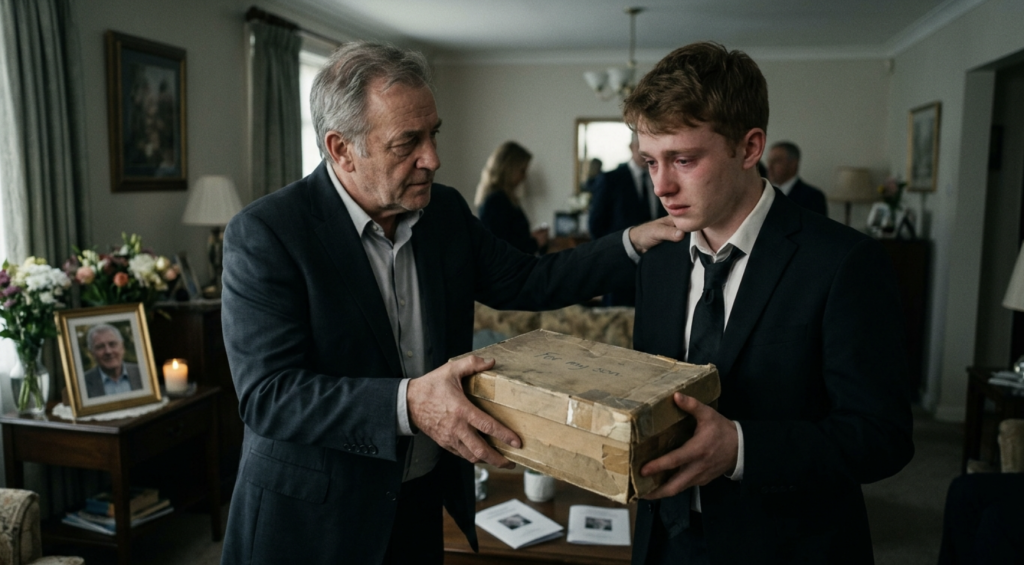
PART 4
I picked them up.
One was a house key. Another belonged to a padlock. The third had a small metal tag attached to it.
On the tag was an address.
It wasn’t our house.
I turned it over.
A unit number was stamped on the back.
“What’s this?”
Marcus straightened.
For the first time that evening, he looked genuinely uncertain.
“I wondered when you’d get to that.”
“You know what it is?”
“I know where the address is.”
“Then tell me.”
Marcus hesitated.
“Your father bought something a few years ago. He told me it was for you, but he never explained exactly what he planned to do with it.”
My heart began to pound.
“What did he buy?”
“A small property on the other side of town. Nothing fancy. It used to be an old repair shop with a little apartment upstairs.”
I stared at him.
“Why would Dad buy a repair shop?”
“Because he thought you might want to work for yourself someday.”
I almost laughed.
My father had never once asked me what I wanted to do with my life.
He’d never encouraged my dreams or helped me make a plan.
And now Marcus was telling me he’d bought a property for a future I hadn’t even known he was imagining.
“Did he expect me to run it?”
“I don’t know. He left the keys and the paperwork with his attorney. The attorney has instructions to contact you after the funeral.”
I looked at the clock.
It was nearly midnight.
My father’s funeral had ended only hours earlier, and I was sitting in the kitchen surrounded by five years of secrets.
I was exhausted.
Angry.
Heartbroken.
And more confused than I’d ever been.
Marcus rose from his chair.
“You don’t have to figure everything out tonight.”
I nodded, though I knew sleep would be impossible.
At the door, he turned around.
“There’s one more thing.”
I looked up.
“Your father asked me to tell you something if you ever started blaming yourself for the way things were between you.”
My throat tightened.
“What?”
Marcus’s eyes were wet.
“He said, ‘Tell my son that being a difficult father was my failure, not his.’”
The words settled over me like a weight.
Marcus opened the door.
“He loved you,” he said quietly. “He just waited too long to show you the way you needed.”
Then he left.
I remained at the kitchen table until dawn, surrounded by letters from a man who had been sitting only a few feet away from me for five years without ever finding the courage to say what he had written on paper.
When the sun finally rose, I gathered everything back into the box.
I almost closed the lid.
Then I noticed a white envelope tucked beneath the notebook.
It hadn’t been labeled with a year.
It had only four words written across the front.
FOR MY SON. OPEN LAST.
My fingers went cold.
I had thought the fifth envelope was the final letter.
Apparently, my father had saved one more secret for the very end.
And whatever was inside it had been important enough that he wanted me to discover everything else first.
I sat back down.
Outside, a delivery truck rumbled past the house. Somewhere down the street, a dog barked.
The world was continuing as if nothing had happened.
But my world had changed.
I opened the envelope.
Inside was a single sheet of paper and a business card for an attorney.
The paper began with a sentence that made my stomach drop.
Son, if you have reached this letter, then you know about the money. You know about the property. And you probably have more questions about me than you had before I died.
There is one final thing you need to know.
The money you paid me was never the only thing I saved.
I stopped breathing for a moment.
Then I continued.
When your mother died, I promised her I would make sure you always had a home. I meant it.
But there was a problem I never told you about.
The house we lived in was not entirely paid off.
I stared at the page.
I had always assumed the house belonged to my father. He had lived there for decades, repaired the roof, replaced the windows, and complained about property taxes.
I’d never questioned whether he still owed money on it.
The letter continued.
After your mother died, I fell behind on several payments. I worked extra shifts and eventually caught up, but years later, when I lost my job for a short period, I borrowed money to keep the house.
I spent years paying that debt back.
By the time you turned eighteen, I was finally close to having everything settled.
I wanted you to have a home that was yours without owing anyone anything.
I read the next paragraph twice.
The house is now paid off.
My hands trembled.
I have left instructions with my attorney to transfer the property to you, along with the savings account and the repair shop.
I lowered the paper.
The house.
The savings.
The repair shop.
For years, I had believed my father was taking from me.
He had been trying to leave me something.
But then I reached the final paragraph.
There is one condition I want you to understand. You are not required to keep the house, the shop, or anything else I leave you. If you want to sell everything and begin again, do it without guilt.
I spent too much of my life believing that providing for you was the same as being there for you.
Don’t make the same mistake with the people you love.
If you become a father someday, sit with your child when they are sad. Ask about their day. Tell them you’re proud of them, even when they fail.
And if you have to choose between buying something you want and spending an hour with someone who needs you, remember that time is the one thing you can never save for later.
I wish I’d learned that sooner.
Love,
Dad.
I laid the letter on the table.
For the first time since his death, I stopped trying to decide whether my father had been a good man or a bad one.
He had been both kind and cruel, generous and emotionally distant, a man who had tried to secure my future while neglecting my present.
He had made mistakes that money couldn’t repair.
And he had left behind a truth I would have to carry for the rest of my life.
I could forgive him.
I could love him.
I could even be grateful for what he had done.
But I didn’t have to pretend that the hurt had never happened.
That morning, I made myself a promise.
I would visit the attorney.
I would see the property.
I would find out what my father had left me.
But I would not spend the rest of my life trying to prove that I deserved the love he had struggled to give.
I had already spent five years doing that.
And I was done.