PART 8
You cooked the meals. You remembered the birthdays. You helped with the house. You treated me with courtesy even when I did not return it.
I told myself that you were fortunate to have what I provided. I never stopped to ask what you were providing to everyone else.
I was wrong.
I also owe Michael an apology, but that is a conversation I must have with my son. I can no longer blame you for the choices he made.
I don’t expect you to forgive me simply because I have finally written these words.
I only hope that one day, if you think of me, you will remember that I was capable of recognizing my mistakes, even if I recognized them far too late.
Eleanor.
I read the letter slowly.
Then I placed it in my desk drawer.
I didn’t call her immediately.
I didn’t rush to reassure her that everything was fine.
Because everything wasn’t fine yet.
But the letter was a beginning.
Several days later, I sent her a brief reply.
I thanked her for acknowledging what had happened and told her that I hoped we could eventually build a more respectful relationship.
I made no promises beyond that.
When we next met, it was for lunch at a restaurant rather than at the mansion.
Eleanor arrived without her usual air of authority. She asked about my business and listened as I explained how it was growing.
For the first time, she asked questions because she was interested in the answers, not because she wanted to evaluate my choices.
Before we parted, she hesitated.
“Would you ever consider visiting the mansion again?” she asked.
I considered the question.
“Perhaps,” I replied. “But only when I feel comfortable doing so.”
She nodded.
“That is fair.”
And we left it there.
Our relationship never became perfect. Some old habits surfaced occasionally, and there were moments when Eleanor still struggled to accept decisions she could not control.
But I no longer surrendered my boundaries to make her comfortable.
And she gradually learned that if she wanted me in her life, she would have to treat me as someone whose presence was a choice, not a privilege she could revoke.
That was the only foundation on which we could begin again.
The Final Visit to the Mansion
Two years later, Charles invited us to a small gathering at the Richardson mansion to mark the completion of the estate review.
The disputed accounts had been addressed through the appropriate legal process. The trustees had clarified the property’s management arrangements, and the remaining responsibilities were documented so that future disagreements would be handled according to the trust rather than personal demands.
Eleanor still lived in the mansion under the rights provided by the trust.
Michael remained a beneficiary, but neither of us treated the property as the measure of our success.
When I entered the dining room, the table was set with the same antique china Eleanor had once forbidden me to use without permission.
She noticed me looking at it.
“I thought we should use the good plates,” she said.
Then, after a pause, she added, “If you’re comfortable with that.”
I smiled.
“Of course.”
We sat down together.
For once, there were no remarks about my clothes, my work, or my place in the family. The conversation was ordinary. Charles discussed the final administrative details, Michael told a story about a client at work, and Eleanor asked about my business.
At the end of the meal, I carried my plate toward the kitchen.
Eleanor stood up immediately.
“Lisa, leave that. I’ll take care of it.”
I paused.
The words were simple, but they carried a meaning I would have understood even if she had said nothing more.
For five years, I had cleared her table because I believed that being useful might help me belong.
Now, she was asking me to sit down because I already did.
I returned to my chair.
Later, as Michael and I prepared to leave, Eleanor walked with us to the front door.
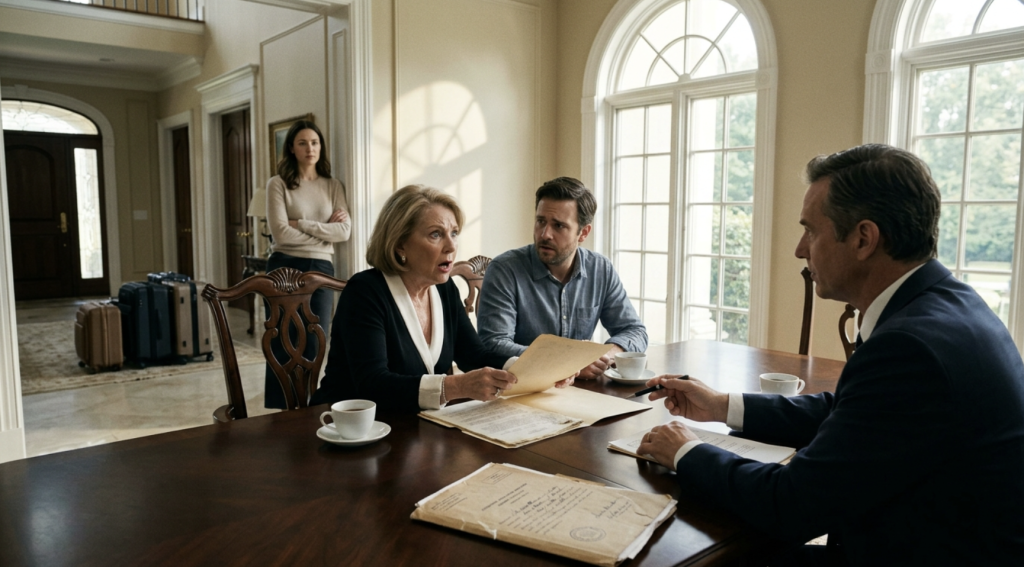
She glanced at the place where my suitcases had stood that terrible night.
“I have thought about that evening many times,” she said.
“So have I.”
“I cannot change what happened.”
“No,” I replied. “But you can choose what happens next.”
She nodded.
Then she looked at me.
“Thank you for giving me the chance to do that.”
I didn’t tell her that I had forgiven everything.
I didn’t need to.
I simply said, “You’re welcome.”
Outside, Michael took my hand.
“Are you okay?” he asked.
I looked back at the mansion.
For a long time, that house had represented everything I thought I needed to earn: acceptance, security, love, and a place in a family that seemed determined to remind me I didn’t belong.
Now it was simply a house.
A beautiful one, certainly, full of history and memories. But it was no longer the center of my life.
My home was somewhere else.
It was the small house where Michael and I had learned to speak honestly. It was the office where I had built a business of my own. It was the quiet confidence I had found when I finally stopped asking other people to decide what I deserved.
I squeezed Michael’s hand.
“I’m more than okay,” I told him.
And I meant it.
As we drove away, I thought about Jonathan’s letter.
You do not need to earn the right to be treated with dignity.
For years, I had mistaken endurance for strength. I had believed that if I remained patient enough, kind enough, and useful enough, eventually someone would decide I was worthy of belonging.
But Jonathan had understood something I had taken far too long to learn.
Respect should never be the prize at the end of someone else’s test.
Love should never require you to disappear.
And a home should never be used as a weapon against the person who lives in it.
The night Eleanor ordered me out of her $2.8 million mansion, I thought I had lost everything.
I hadn’t.
I had lost the illusion that I could earn love by accepting humiliation.
I had lost the habit of remaining silent when something was wrong.
And I had lost the fear that walking away from a beautiful house meant walking away from a beautiful life.
In their place, I found something far more valuable.
I found my voice.
I found my independence.
And, eventually, I found a marriage worth rebuilding—not because I had been forced to stay, but because we had both learned what it meant to choose each other freely.
The mansion remained part of the Richardson family’s history.
But it no longer determined my future.
Because the greatest inheritance Jonathan left me was never the trust, the money, or the legal protection.
It was the reminder that my dignity had never belonged to anyone else.
And no one—not even the owner of a $2.8 million mansion—had the right to take it away.