PART 7
My Mother-in-Law Kicked Me Out of Her $2.8 Million Mansion
Then, unexpectedly, her expression crumpled.
“You don’t know what it was like,” she whispered. “After Jonathan died, everything felt as though it was slipping away. The house, the business, the life I had spent decades building. I thought if I didn’t keep control of everything, I would lose it all.”
I listened without interrupting.
“I didn’t want another woman coming into this family and changing everything,” she continued. “I thought Michael would forget me. I thought I would become a guest in my own life.”
Her voice trembled.
“And I suppose I made you feel like a guest in yours.”
The admission was so unexpected that I didn’t immediately know how to respond.
It wasn’t a complete apology.
It didn’t erase the past.
But it was the first time Eleanor had acknowledged what she had done without blaming me for it.
“Yes,” I said. “You did.”
She looked down at her hands.
“I was cruel to you.”
The room became silent.
“I told myself I was protecting the family,” she continued. “But I was protecting my control over it. I thought if you never felt secure here, you would always have to seek my approval.”
Michael stepped away from the window.
“Mom, why didn’t you just tell us you were afraid?”
She looked at him sharply.
“Because I didn’t know how to be afraid without becoming angry.”
For a moment, I saw the grief beneath her pride.
Jonathan’s death had changed her. Losing her husband had left a space in her life that money and property could not fill.
But grief did not excuse her behavior.
I could recognize her pain without accepting responsibility for it.
“I am sorry for what happened to you after Jonathan died,” I said. “I know losing him must have been devastating. But you cannot make other people smaller to make yourself feel safe.”
Eleanor nodded slowly.
Then she looked at Michael.
“And you,” she said. “You let this happen.”
Michael’s face tightened.
“Yes,” he replied. “I did.”
She appeared startled by his answer.
“I was afraid of upsetting you,” he continued. “So I let Lisa suffer instead. I told myself I was keeping peace, but I was only protecting myself from an uncomfortable conversation.”
He took a breath.
“I should have defended my wife. I should have spoken to her before packing her things. And I should have stopped pretending that your approval was more important than doing what was right.”
Eleanor began to cry.
Michael did not rush to comfort her, nor did he turn toward me as if expecting me to rescue the conversation.
He remained where he was.
It was the first time I had seen him allow his mother to experience the consequences of her actions without immediately trying to make everything comfortable again.
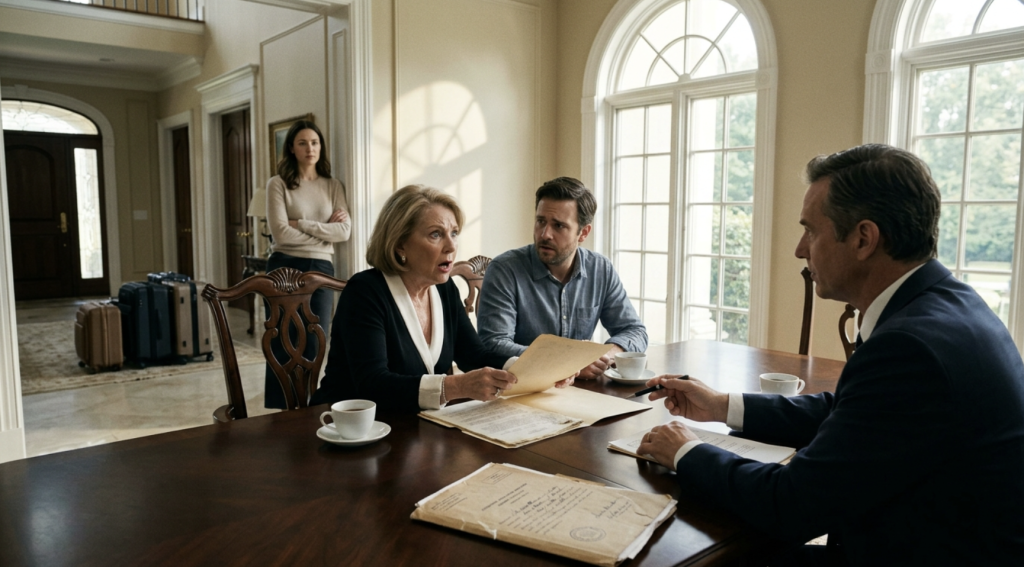
Charles gathered his papers.
“The legal matters will continue through the appropriate process,” he said. “But personal reconciliation is something you must decide for yourselves.”
I stood.
“I need to say one more thing before I leave.”
Eleanor looked up.
“I don’t want your money. I don’t want your position in the family. And I don’t want to take this mansion away from you.”
I paused.
“I want a life where I can walk into a room without wondering whether I am allowed to belong there. I want a marriage where my husband treats me as an equal. And I want to know that if I disagree with someone, I won’t be punished by having my home or my belongings taken away.”
I looked directly at Eleanor.
“If we ever have a relationship again, it will have to be built on respect. Not fear. Not money. Not the threat of being thrown out.”
She nodded, tears running down her face.
“I understand.”
For the first time, I believed she might be beginning to understand.
But forgiveness would take longer.
And I no longer felt obligated to rush it.
Six Months Later: A Different Kind of Home
Six months after that first morning with Charles, my life looked very different.
I had returned to work and begun taking on additional accounting clients. With the money I had saved and the confidence I had slowly regained, I started planning the small bookkeeping business I had once discussed with Jonathan.
I rented a modest office above a neighborhood bakery.
The windows were old, the stairs creaked, and the walls needed painting.
I loved it.
Every decision was mine.
I chose the furniture, arranged the shelves, and decided where the coffee machine belonged. No one criticized the color of the curtains or told me that my plans were inappropriate for someone of my position.
On the first morning of business, I stood in the doorway holding a cup of coffee and watched the sunlight fall across my desk.
I thought about the mansion.
For years, I had believed that living in a beautiful house meant I had succeeded. I had tried so hard to be accepted that I had almost forgotten the difference between comfort and happiness.
Now I understood that a home was not defined by its market value.
It was defined by whether you could breathe freely inside it.
My marriage with Michael was still uncertain, but it was no longer built on the assumption that I would absorb every insult to keep everyone else comfortable.
We attended counseling together.
He continued living separately for a time, learning to make decisions without asking his mother to approve them. He also began setting boundaries with Eleanor, even when those boundaries disappointed her.
He never demanded that I return to the mansion.
Instead, he asked what kind of life I wanted to build.
For the first time, he listened to the answer without trying to negotiate it into something easier for him.
One evening, we sat in a small restaurant near my office.
Michael had brought a notebook.
“I’ve been thinking about what you said,” he began. “About building a life where you don’t have to wonder whether you belong.”
I waited.
“I don’t expect you to come back just because I finally understand what I should have done. I know I have to show you that I can be different.”
He opened the notebook.
“I’ve written down some things I want to change. Not rules for you. Things for me.”
He showed me a list.
He would make decisions about our marriage with me rather than allowing his mother to make them for us. He would speak up when someone disrespected me. He would not use money, property, or family obligations as a reason to control my choices.
And if he failed, he would acknowledge it rather than making me responsible for explaining why I was hurt.
I read the list and closed the notebook.
“These are good promises,” I said. “But I need to see them become habits.”
“I understand.”
We continued counseling.
Over time, Michael became more consistent. He stopped treating every disagreement as a crisis and stopped assuming that peace required someone to surrender.
He began asking himself whether a decision was fair, rather than simply whether it would make his mother happy.
And slowly, I began to trust him again.
Not because of his father’s estate.
Not because of the mansion.
Because he was finally learning to take responsibility for his choices.
Eventually, we agreed to rebuild our marriage, but with one important condition.
We would not live in Eleanor’s mansion.
We found a smaller house in a quiet neighborhood, purchased according to our own financial circumstances and with independent legal advice. It had a modest garden, a bright kitchen, and enough room for the life we wanted.
The first evening we spent there, Michael carried in the last box and placed it beside the dining table.
Then he looked around.
“It’s not much compared with Mom’s house,” he said.
I smiled.
“That’s exactly what I like about it.”
He laughed softly.
For a moment, we were the people we had been when we first fell in love: two imperfect adults trying to build something together.
The difference was that this time, we were no longer pretending love alone would solve every problem.
We were choosing to do the work.
Eleanor’s Final Letter
A year after the night she ordered me out, I received a letter from Eleanor.
It arrived at my office on a rainy Thursday afternoon.
The envelope contained no legal documents, no demands, and no accusations.
Only three handwritten pages.
Lisa,
I have started writing this letter several times. Each time, I found myself explaining why I behaved the way I did.
I wanted to tell you about losing Jonathan, about my fear of growing older, and about the feeling that everything I had built was slowly slipping beyond my control.
All those things were true.
But none of them changed what I did to you.
I made you feel that you were living in my home on borrowed time. I treated your kindness as an obligation and your patience as permission to continue. When you tried to become part of this family, I made you prove yourself over and over again.
The worst part is that you kept trying.
THE NEXT PART 8 👇