PART 6
“Because I need to learn how to live without having every decision made for me. And because I understand that you don’t want to return to the mansion right now.”
He paused.
“I also told Mom that I won’t participate in any decision about your belongings or your residence without first understanding the legal arrangements and speaking to you directly.”
It was the first meaningful action he had taken without asking me to manage his feelings about it.
But I wasn’t ready to reward him for doing what should have been ordinary.
“I’m glad you did that,” I said. “But it doesn’t change what happened.”
“I know.”
We sat quietly until our coffee grew cold.
When we finally stood to leave, Michael didn’t ask me to come home.
He didn’t ask me to forgive him.
He simply said, “I’m sorry, Lisa.”
This time, I believed that he understood what he was apologizing for.
Whether he could become a better husband remained a different question.
The Financial Records Reveal a Bigger Problem
Over the following two weeks, Charles worked with an independent accountant to examine the Richardson estate’s records.
I remained at the hotel for several nights before moving into a small furnished apartment.
It was nothing like the mansion.
There were no marble floors, no enormous windows, and no landscaped gardens. The kitchen was barely large enough for two people to stand in comfortably.
But I could leave my shoes wherever I wanted.
I could cook without someone inspecting my food.
I could sit in silence without wondering whether my presence was irritating anyone.
Every evening, I returned to that little apartment and felt a kind of peace I hadn’t experienced in years.
Meanwhile, the financial review uncovered several questionable transactions.
The property company receiving recurring payments had been established by an associate of Eleanor’s. Some of the invoices described services that had not been adequately documented. Other payments appeared to overlap with expenses already recorded elsewhere.
The accountant could not yet determine whether the transactions represented improper payments, careless recordkeeping, or legitimate expenses supported by missing documents.
But the pattern was serious enough to warrant a more thorough examination.
Charles sent a formal request for the remaining records.
Eleanor responded with anger.
She accused him of humiliating her and allowing Lisa to interfere in private family matters.
Charles replied that the review was required by his professional responsibilities and the estate documents.
Then came a discovery that changed the entire dispute.
A transfer of funds had been made from an account associated with the estate into a separate investment account. The transaction was not automatically unlawful, but the authorization records were incomplete, and the money had not been clearly accounted for in the estate’s summaries.
The amount was large enough that the accountant recommended an independent investigation.
Charles contacted the appropriate professionals, preserved the records, and advised the family not to move or dispose of any disputed assets while the matter was being examined.
When Eleanor learned about the recommendation, she called Michael.
I wasn’t present for the conversation, but he told me about it afterward.
“She said Dad would be ashamed of me,” he explained during one of our scheduled conversations.
“What did you say?”
“I told her Dad’s wishes couldn’t be established by whichever one of us shouted loudest. I told her we had to let the review happen.”
“And how did she react?”
“She said I had changed.”
I looked at him.
“What did you tell her?”
“That I hoped I had.”
For the first time, Michael had disagreed with his mother without immediately calling me afterward to complain about how upset she was.
It was a small step, but it was a real one.
The review continued.
Several weeks later, the accountant concluded that some payments had been poorly documented and that certain transfers required further explanation. There was not enough evidence to establish that Eleanor had personally stolen money, and Charles cautioned everyone against making accusations before the investigation was complete.
The estate’s trustees restricted certain transactions while they obtained additional records.
Eventually, the property company produced some of the missing invoices. Several expenses were legitimate, but others could not be adequately substantiated. The disputed sums were referred for further review, and the trustees began the process of recovering amounts that could not be justified under the governing arrangements.
Eleanor was furious.
She claimed that everyone had turned against her.
But the documents did not care who felt betrayed.
They simply required answers.
And for the first time, Eleanor could not end a difficult conversation by declaring that the house belonged to her and everyone else needed to obey.
The Confrontation at the Mansion
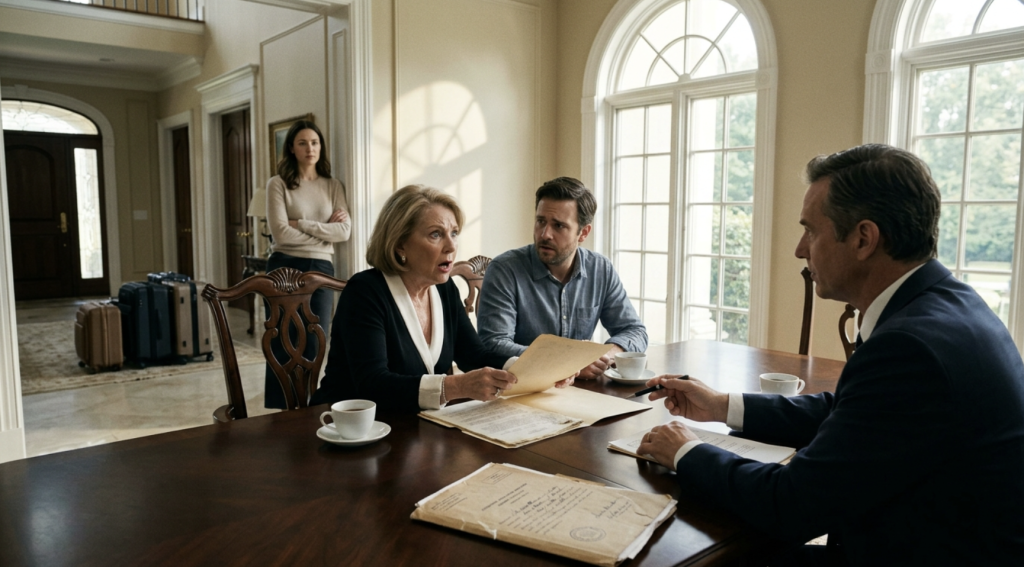
Three months after I left, Charles arranged a meeting at the mansion.
The purpose was to review the findings, explain the trust’s requirements, and discuss how the household would operate going forward.
I almost declined.
I had no desire to return to the place where I had been humiliated.
But I decided that if I was going to close this chapter of my life, I would do so on my own terms.
When I arrived, Eleanor was sitting in the drawing room.
She wore her usual pearls and cream blouse, but her expression was different. The old certainty had been replaced by a brittle defensiveness.
Michael stood near the window.
Charles placed the final review documents on the table.
“The investigation has clarified several important issues,” he began. “The mansion remains subject to the family trust. Eleanor retains the rights granted to her under its terms, while other decisions must be made in accordance with the trust’s provisions. No individual family member has unrestricted authority over every aspect of the property.”
Eleanor looked away.
“The financial review also identified expenses that were inadequately supported. Some have now been explained, while others remain subject to recovery or further review. The trustees will continue to manage those matters according to their legal obligations.”
She pressed her lips together.
Then she turned to me.
“Are you happy now?”
I had imagined this moment many times.
In some versions, I would tell her everything I had wanted to say for five years. I would describe every insult and every humiliation. I would make her understand how much damage she had done.
But sitting across from her, I realized I no longer needed her to understand me in order to move forward.
“No,” I answered quietly. “I’m not happy that the family has gone through this. I’m relieved that the truth is finally being examined.”
She gave a dismissive laugh.
“You could have stayed out of it.”
“You told me to leave the house. Your son packed my belongings. I had every right to understand my legal position.”
“You could have handled it privately.”
“I tried handling things privately for five years. I stayed quiet when you criticized me. I stayed quiet when you treated me as though I didn’t belong. I stayed quiet when your son refused to defend me.”
I paused.
“Being quiet didn’t make the situation better. It only made it easier for everyone else to ignore.”
Eleanor’s eyes flashed.
“You have turned Michael against me.”
“No,” I said. “Michael is responsible for his own choices. I cannot control his relationship with you, and I don’t want to. I only want him to understand that loving you doesn’t require him to mistreat me.”
For a long moment, she said nothing.