PART 4
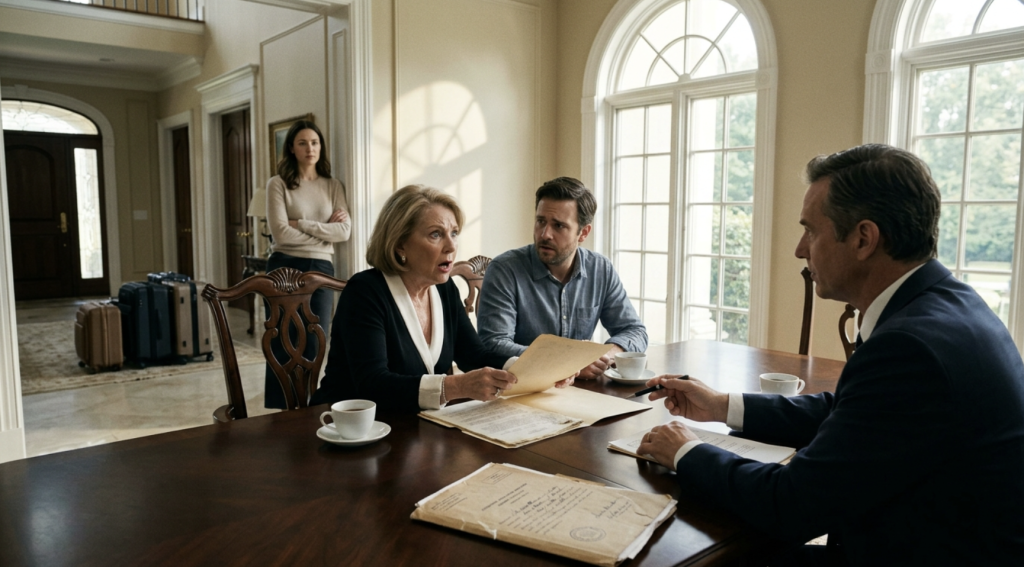
“That depends on the legal findings and what Lisa herself wants. She is not required to make a decision in this room under pressure.”
For the first time that morning, I felt as though someone had opened a window in a house that had been suffocating me for years.
I stood and picked up my purse.
“I don’t want to take anything that doesn’t belong to me,” I said. “I don’t want to punish anyone, and I don’t want this house simply because it is expensive. I want the truth. And I want the right to make my own decisions about my life.”
Charles nodded.
“That’s a sensible place to begin.”
I walked toward the hallway.
Michael followed me.
“Lisa, wait.”
I stopped near the front door, beside the spot where my suitcases had stood the night before.
“Can we talk?”
I looked at him.
“About what?”
“About us.”
I almost asked him where that conversation had been when he packed my things. I almost asked why he had let his mother humiliate me for five years.
Instead, I waited.
Michael glanced back toward the dining room.
“I didn’t know about Dad’s documents.”
“I believe you.”
Relief crossed his face, but I wasn’t finished.
“But you knew you were packing your wife’s belongings because your mother told you to. You knew I hadn’t been asked what I wanted. And you still did it.”
He lowered his eyes.
“I thought if I went along with her, things would calm down.”
“They always calm down for you, Michael. You make me carry the pain, and then you call it peace.”
He looked as though he wanted to argue.
Then he closed his mouth.
I opened the door.
“I’m going to stay at the hotel for now. I need time to think, and I need you to think about what happened without your mother telling you how to explain it.”
“Are you leaving me?”
I studied his face.
Five years earlier, I might have rushed to reassure him. I might have promised that everything would be fine if he would only stand beside me for once.
Now, I understood that I couldn’t repair a marriage by myself.
“I haven’t decided what happens to our marriage,” I told him. “But I know I can’t return to the way things were.”
Then I stepped outside.
Behind me, the door closed softly.
This time, it was my choice to leave.
And that made all the difference.
By noon, Charles had sent me a message asking whether I could meet him at his office the following afternoon.
He wanted to explain a provision in Jonathan’s letter that he had deliberately postponed discussing in front of Eleanor.
I agreed.
That evening, I sat by the hotel window with a cup of tea and watched traffic move along the highway. My phone buzzed repeatedly.
Michael called six times.
Eleanor sent two messages.
The first read, I hope you’re satisfied with the disruption you’ve caused.
The second arrived twenty minutes later.
You should think very carefully about what happens when this family decides you are no longer welcome.
I read it twice.
Then I took a screenshot and forwarded it to Charles, asking whether he needed it for the file.
He replied almost immediately.
Please preserve all communications. Do not respond to threats. We’ll discuss everything tomorrow.
I put my phone down.
For the first time in years, I didn’t feel the urge to explain myself.
I didn’t have to convince Eleanor that I was a good person. I didn’t have to persuade Michael to recognize my pain. I didn’t have to apologize for asking questions about documents that affected my life.
I could simply wait for the truth.
The following afternoon, I arrived at Charles’s office shortly before two.
He had prepared a small conference room with the estate folder, several financial statements, and a copy of Jonathan’s handwritten letter.
“Before we begin,” he said, “I want you to understand something. Jonathan did not leave these arrangements because he expected you to fight with his family. He created them because he believed clear rules could protect people when personal relationships became difficult.”
I sat down.
“What exactly did he leave me?”
Charles didn’t answer immediately.
Instead, he opened the folder and showed me a document with my name printed near the top.
It was a declaration establishing a separate family trust provision for a future spouse of Michael Richardson.
My hands went cold.
“I’m listed as the beneficiary?”
“Potentially, yes, subject to the conditions in the document and the applicable law. Jonathan wanted the person Michael married to have an independent measure of security. He specifically stated that the arrangement should not be used to control that person’s choices.”
I looked at the page.
There were provisions concerning a separate investment account, a designated share of certain trust income, and protections against unilateral changes by other family members.
But the most important clause was written in plain language.
The beneficiary’s rights were not to depend on obedience to the wishes of another family member.
I read it again.
“Why would Jonathan do this for someone he barely knew?”
Charles smiled sadly.
“He knew enough to recognize the kind of person you were. He also knew his family. He worried that whoever married Michael might find herself in a difficult position if she didn’t fit the expectations Eleanor had established.”
I remembered Jonathan sitting with me on the back terrace during one of my earliest visits.
He had asked about my work, my parents, and the things I hoped to accomplish.
When I told him that I wanted to open a small bookkeeping service someday, he had listened with genuine interest.
“Never give up having a life of your own,” he had told me. “Marriage should add to your life, not erase it.”
At the time, I had thought he was simply being kind.
Now I wondered how much he had seen.
“Did Michael know about any of this?” I asked.
“Not about the full arrangement. Jonathan left him a separate letter, which I delivered after his death. Michael acknowledged receiving it, but he never requested the supporting documents.”
“Why not?”
Charles leaned back.
“I can’t tell you what Michael was thinking. But I can tell you that your father-in-law anticipated that some of these provisions might be ignored until someone had a reason to examine them.”
He slid another paper across the table.
“This is where matters become more complicated. The trust’s financial records show that a number of payments were made over several years. Some appear ordinary. Others require explanation.”
I looked at the figures.
Maintenance expenses. Property management fees. Transfers between accounts.
Then I noticed a recurring payment that had been made every month for nearly three years.
The amount was substantial.
The recipient was a private property company I had never heard of.
“What’s this?” I asked.
Charles turned the statement toward himself.
“That is one of the transactions we need to investigate. The company was involved in managing certain Richardson assets. The payments were described as administrative and property-related expenses, but the supporting records are incomplete.”
“Who authorized them?”
“The available documents suggest Eleanor had a role in approving some of the transactions. That does not establish wrongdoing by itself. We need the underlying records before drawing conclusions.”
I studied the dates.
Several payments had occurred during the final months of Jonathan’s life.
Others continued long after his death.
Then I noticed something that made my stomach tighten.
One transfer had been made only two days before I married Michael.
Another had occurred the week after our first wedding anniversary.
And the latest payment was dated just six weeks earlier.
“Charles,” I said quietly, “why would a property company continue receiving money if no one can explain what services it provided?”
“That is precisely the question I intend to ask.”
He gathered the statements.
“I don’t want you to jump to conclusions. There may be legitimate explanations. But until we have them, the estate’s records must be protected and reviewed.”
I nodded.
Then I asked the question that had been troubling me since the morning before.
“Does this mean Eleanor knew she couldn’t simply throw me out?”
Charles considered his answer carefully.
“It means she should not have assumed that she had unrestricted authority over the property or over your rights. Whether she understood the full legal position is something we still need to establish.”
I stared at the documents.
For five years, Eleanor had told me that I was fortunate to live in her house.
She had made me feel as though every dinner I cooked, every repair I arranged, and every holiday I helped prepare was payment for the privilege of being tolerated.
Yet Jonathan had created legal protections without asking me to prove that I deserved them.
He had not given me those protections because I had served his family well.
He had given them because I was a person who deserved to be treated fairly.
That distinction changed something inside me.
Before leaving, Charles handed me a sealed envelope.
“Jonathan wrote this separately. The instructions say it should be given to you personally if you ever become involved in a dispute concerning your residence or financial independence.”
My name was written across the front in his familiar handwriting.
I held it carefully.
“May I read it now?”
“Of course.”
I opened the envelope.
Inside was a single page.
Dear Lisa,
If you are reading this, I hope it is because you have found the courage to ask questions that others would prefer you not ask.
I don’t know what your life with Michael will become. I cannot predict whether my family will make you feel welcome or whether you will sometimes wonder if you belong.
But I want you to remember one thing.
You do not need to earn the right to be treated with dignity.
If you choose to stay, let it be because you are loved and respected. If you choose to leave, let it be because you believe another life will be better for you.
Do not remain somewhere merely because someone has convinced you that you have nowhere else to go.
The truth may take time to uncover. Be patient with the process, but never surrender your judgment to someone else’s pride.
With respect and affection,
Jonathan.
I couldn’t speak for several seconds.
Then I folded the letter and held it against my chest.
Outside the conference room, people hurried through the corridor, carrying files and answering phones. The world continued as it always had.
But for the first time since I had married Michael, I felt that my future belonged to me.
I still didn’t know what the documents would reveal.
I didn’t know whether my marriage could survive what had happened.
And I certainly didn’t know why Eleanor had reacted with such fear when she saw Jonathan’s signature.
But I knew one thing.
I was no longer going to spend my life begging for a place at a table where everyone else believed they had the right to decide whether I belonged.
And as I slipped Jonathan’s letter into my purse, Charles spoke again.
“Lisa, there’s one more document I haven’t shown you.”
I turned toward him.
He reached into the folder and removed a sealed envelope marked with a date from seven years earlier.
“Your father-in-law instructed me to open this only if the estate’s financial records came under formal review. Given what we’ve discovered, I believe that time has arrived.”
He placed it between us.
Then he looked at me with an expression that made my heart begin to race.
“Whatever is inside this envelope, Lisa, it may explain why Jonathan was so determined to protect the person Michael eventually married.”