PART 3
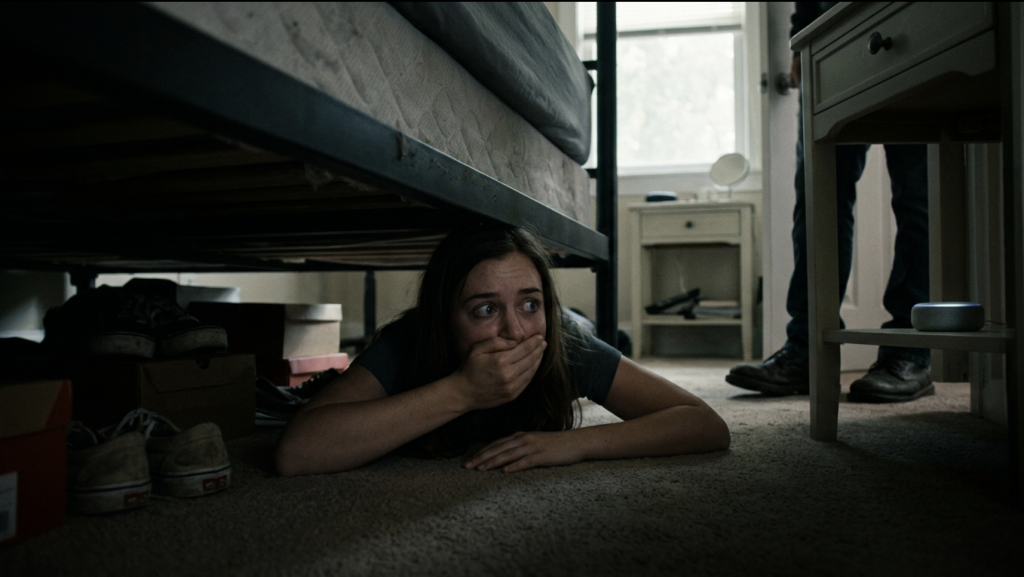
The woman turned toward the bed.
My fingers tightened around my phone.
“Yes. Everything looks normal.”
“Then stop worrying. Laura always finds a reason to worry about something. She’ll convince herself it’s her imagination before she admits something is wrong.”
The cruelty in his voice hurt more than the shock of hearing it.
That was Mark.
The same dry humor. The same impatient tone. The same little pause before he said something designed to make me feel foolish.
I knew every detail of that voice.
I had listened to it for eleven years.
And now it was coming from a phone held by a stranger in my bedroom.
The woman laughed quietly.
“You really know your wife.”
“I know Laura better than she knows herself.”
I squeezed my eyes shut.
I wanted to scream his name. I wanted to crawl out from under the bed, grab the woman by her expensive jacket, and demand an explanation.
But something inside me understood that if I moved too soon, I might never learn the truth.
So I stayed still.
The woman walked toward the dresser.
I heard drawers opening, followed by the rustling of papers.
“Did you find it?” Mark asked.
“Not yet.”
“Look in the bottom drawer. Behind the old insurance documents.”
I stopped breathing again.
The bottom drawer contained paperwork from the accident that had supposedly killed him. Police reports, insurance correspondence, and the final documents related to his death.
I had barely touched them since the funeral.
The woman pulled out a thick folder.
“Here it is.”
“Good. Take pictures of everything. Especially the last page.”
“What if she already found it?”
“She hasn’t. If she had, we wouldn’t be having this conversation.”
The woman was silent for a moment.
Then she asked a question that made my stomach twist.
“What are we going to do about Laura?”
Mark didn’t answer immediately.
When he finally spoke, his voice had lost its casual warmth.
“That depends on how much she knows.”
“And if she knows everything?”
A long silence followed.
Then he said five words.
“Then we change the plan.”
The call ended.
I heard the woman sigh, close the folder, and place it inside her handbag.
For several seconds, she stood completely still.
Then her phone rang again.
She answered immediately.
“Hello?”
This time, she wasn’t using the speaker.
I could hear only her side of the conversation.
“No, not yet. I told you, I have to be careful.”
A pause.
“I know what the agreement says.”
Another pause.
Her voice dropped to a whisper.
“Because if he discovers I kept the original, we’re both finished.”
My eyes flew open.
The original what?
She ended the call and walked toward the bedroom door.
Before leaving, she stopped.
“Laura,” she called softly.
Every muscle in my body locked.
“Are you home?”
I pressed my hand over my mouth.
She waited.
Five seconds.
Ten.
Then she chuckled.
“Of course you’re not.”
Her heels clicked down the hallway.
I heard the front door open and close.
Then silence.
I remained beneath the bed for another twenty minutes, unable to convince myself that she had really left.
When I finally crawled out, my knees were trembling so badly that I had to grip the mattress to stand.
The room looked exactly as it had before.
The bed was neatly made.
The curtains were open.
Mark’s photograph sat on the nightstand.
But I was no longer the woman who had entered that house that morning.
I walked to the dresser and opened the bottom drawer.
The folder was still there.
At first, I thought the woman had taken nothing.
Then I noticed a gap between two documents.
Something was missing.
I emptied the drawer onto the bed, sorting through the papers with shaking hands.
Insurance policies.
The police report.
The certificate of death.
The documents from the funeral home.
And a photocopy of a page from Mark’s life insurance agreement.
But the final page was gone.
I remembered it clearly.
It contained the beneficiary details and a handwritten note from Mark’s insurance representative. Two weeks before the accident, he had asked me to sign a document confirming that our financial information was accurate.
I had signed it without hesitation.
I trusted him.
Now I wondered what else I had signed without reading.
I photographed every remaining page and placed everything back in the drawer.
Then I checked the security camera app on my phone.
I had installed two cameras after a package disappeared from my porch the previous year. One faced the front entrance, and the other covered the driveway.
I had never bothered to review the recordings unless something happened.
My fingers moved clumsily as I opened the app.
The front-door camera showed me leaving at 8:02 a.m.
At 8:17, a black sedan pulled into the driveway.
A woman stepped out.
The same woman who had been standing beside my bed.
She unlocked the front door with a key.
At 12:06 p.m., she left.
But then I noticed something.
The camera timestamp showed that she had entered the house at 8:17.
My neighbor had complained about screaming for three consecutive days.
Which meant the woman had been visiting long before I had discovered her.
I opened the recordings from the previous week.
Monday.
Tuesday.
Wednesday.
Every day, the same black sedan arrived.
Every day, the woman entered my house.
And every day, she left before I returned from work.
On Tuesday’s recording, she carried a large cardboard box.
On Wednesday, she left with a suitcase.
Then I opened Monday’s footage and zoomed in on the moment she unlocked the door.
Her face turned briefly toward the camera.
I recognized her.
Not from the neighborhood.
Not from work.
From Mark’s funeral.
She had stood near the back of the church, wearing a black dress and a veil that partially covered her face.
I remembered because she had been crying harder than anyone else.
At the time, I had assumed she was a distant relative or an old friend of Mark’s.
I had even wondered why she had disappeared before I could speak to her.
Now I understood that she hadn’t been mourning him.
She had been saying goodbye to someone she knew was still alive.
I enlarged the image until her face became grainy.
Then I whispered the name I had tried to forget.
“Rebecca.”
Rebecca Shaw.
Mark’s former executive assistant.
She had worked with him for almost six years before leaving the company eighteen months before his supposed death.
I remembered meeting her at office parties.
She was always polite, always professional, and always seemed to know what Mark was thinking before he spoke.
Once, when I joked that she probably knew my husband’s schedule better than I did, she had smiled and said, “Sometimes, Mrs. Miller, I think I do.”
Mark had laughed.
I hadn’t thought anything of it.
Now the memory made me feel sick.
I searched my email for her name.
Nothing.
I searched Mark’s old messages.
Most of his accounts had been closed after his death, but one shared family email remained accessible.
I found an old message from Rebecca dated three weeks before the crash.
Subject: The documents you requested
The message contained no text, only an attachment.
My hands trembled as I opened it.
The attachment was a scanned document titled Asset Transfer and Contingency Agreement.
I didn’t understand all the legal language, but I understood enough to see that Mark had been preparing to transfer several financial assets into a company I had never heard of.
The date was significant.
It was signed twelve days before his accident.
At the bottom, beneath Mark’s signature, was the name of another person.
Rebecca Shaw.
I scrolled down.
Then I found a third signature.
Mine.
I stared at it.
It looked exactly like my signature.
But I had never seen the document.
Someone had copied my signature onto an agreement involving assets I didn’t know existed.
I printed the document and laid it on the kitchen table.
For the first time in two years, I stopped thinking about how much I missed my husband.
Instead, I began asking myself a much more dangerous question.
What if Mark’s death had been the beginning of a plan rather than the end of his life?
My phone rang.
I nearly dropped it.
The caller ID displayed an unknown number.
I answered without speaking.
A man’s voice came through.
“Mrs. Miller?”
“Yes?”
“My name is Daniel Brooks. I was a claims investigator working on your husband’s accident.”
My heart began to pound.
I remembered Daniel.
He had visited me twice after the crash, asking questions about Mark’s schedule, his vehicle, and whether he had seemed unusually anxious in the days before his death.
I hadn’t heard from him in almost two years.
“Why are you calling me?” I asked.
“Because something has happened, and I believe you need to hear it from me before someone else contacts you.”
I gripped the edge of the table.
“What happened?”
“Yesterday, I received a request to reopen the investigation into your husband’s life insurance claim.”
“That doesn’t make sense. The claim was settled.”
“Exactly. That’s why I started looking into it again.”
I looked at the papers spread across my table.
“Mr. Brooks, I need to ask you something.”
“Go ahead.”
“Are you absolutely certain my husband died in that accident?”
He didn’t answer.
The silence was so long that I checked whether the call had disconnected.
Finally, he spoke.
“Mrs. Miller, the police identified the victim based on the vehicle and the circumstances of the crash. The remains were badly damaged, and the identification process relied heavily on the available records.”
My mouth went dry.
“What does that mean?”
“It means that two weeks ago, I discovered a discrepancy in the medical records associated with the death certificate.”
“What kind of discrepancy?”
“A hospital record bearing your husband’s name was entered into a separate insurance database four months after his supposed death.”
I sat down.
“That could be a clerical error.”
“It could,” he agreed. “But there is another problem.”
“What?”
“The record contains a signature from someone who claimed to have verified his identity.”
“Who?”
Daniel took a breath.
“Rebecca Shaw.”
For a moment, I couldn’t speak.
Then I forced the words out.
“Mr. Brooks, I think Rebecca is coming into my house.”
“What?”
“She has a key. She’s been here while I’m at work. Today, I heard her speaking to someone on the phone.”
“Who was she speaking to?”
I closed my eyes.
“My husband.”
Daniel didn’t interrupt.
“He’s supposed to be dead,” I continued. “But I heard his voice. I know it was him.”
When Daniel finally spoke, his voice was careful.
“Laura, listen to me. Don’t confront Rebecca. Don’t contact anyone who might be connected to your husband’s business. And don’t assume the person you heard is necessarily Mark until we establish that.”
“Why?”
“Because if someone has been using your husband’s identity, they may be willing to do much more than steal money to protect it.”
I glanced toward the hallway.
The house suddenly felt unfamiliar.
“Can you help me?”
“Yes. But first, I need you to do something.”
“What?”
“Check whether your husband left you anything that he specifically told you never to open.”
I thought about it.
Mark had been meticulous about paperwork. He kept everything in labeled folders, from tax returns to receipts for appliances.
But there was one thing.
A small wooden box in the attic.
He had given it to me on our tenth wedding anniversary, telling me it contained documents that belonged to his father.
He had asked me to leave it alone unless something happened to him.
At the time, I had laughed and asked whether he was hiding a treasure map.
He had kissed my forehead and said, “Something like that.”
I had never opened it.
“I have a box,” I told Daniel.
“Where?”
“In the attic.”
“Don’t open it yet. I’m going to come over, and we’ll examine it together.”
“When?”
“As soon as I can.”
Before he ended the call, he added one more thing.
“Laura, whatever you do, don’t spend tonight in that house alone.”
I promised I would consider it.
But after the call ended, I didn’t pack a bag.
I climbed the stairs to the attic.
The wooden box was exactly where I remembered it, tucked behind a stack of old Christmas decorations.
It was smaller than a shoebox, with brass corners and a lock.
A thin layer of dust covered the lid.
I carried it downstairs and placed it on the kitchen table.
There was no key attached.
I examined the lock and found a tiny inscription engraved into the brass.
For Laura, when the truth becomes more dangerous than the lie.
I felt tears sting my eyes.
Mark had written those words.
I knew his handwriting.
And suddenly, I remembered something he had said during the final week before his accident.
We had been sitting in the kitchen after dinner when he reached across the table and held my hand.
“Laura, if anything ever happens to me, promise you’ll never let anyone make you feel guilty for protecting yourself.”
I had laughed nervously.
“Why are you talking like that?”
He had smiled, but his eyes had looked frightened.
“Just promise me.”
I had promised.
For two years, I had believed he was asking me to be strong after his death.
Now I wondered whether he had been trying to warn me about what would happen if he disappeared.
I searched the box for a key.
Nothing.
Then I remembered the photograph beneath my bed.
The folded photograph I had noticed while hiding.
I had been too frightened to retrieve it earlier.
I went back upstairs, dropped to my knees, and reached beneath the bed.
The photograph was still there.
It showed Mark standing beside a black sedan, wearing a dark coat and sunglasses.
Beside him stood Rebecca.
But there was someone else in the picture.
A man whose face I had never seen before.
He was holding a newspaper, his expression hidden behind the raised pages.
On the back of the photograph, Mark had written a date.
The date was six months after his funeral.
I stared at it until the numbers blurred.
If the photograph was genuine, then someone had been meeting Mark after the world believed he was dead.
I turned it over again.
Beneath the date were four words.
The key is with her.
Her.
Rebecca?
Or someone else?
I returned to the kitchen and examined the wooden box again.
This time, I noticed a small metal plate attached to the bottom. I pressed it, and a hidden compartment slid open.
Inside was a tiny brass key.
I inserted it into the lock.
It turned.
The lid opened with a soft click.
Inside were three things: a sealed envelope addressed to me, a flash drive, and a second photograph.
The second photograph showed Mark standing outside a hospital entrance.
He looked thinner than I remembered, with a pale face and a bandage visible beneath his collar.
The date printed on the photograph was four months after his death.
My knees nearly gave way.
I opened the envelope.
The letter inside was written in Mark’s handwriting.
Laura,
If you’re reading this, then something has gone wrong, and I have failed to keep you away from a truth that should never have touched your life.
I know you will be angry. You have every right to be.
But before you decide what kind of man I am, please listen to the recording on the flash drive.
There are things I cannot explain in writing.
Do not trust Rebecca.
Do not trust anyone who tells you they are protecting you.
And whatever happens, do not let them convince you that I died on Route 70.
I love you.
Mark.
I read the letter three times.
Then I picked up the flash drive.
I had just found an old laptop in the study when someone knocked on the front door.
Three sharp knocks.
I froze.
Through the frosted glass, I saw a tall figure standing on the porch.
A man.
He lifted his hand and knocked again.
“Laura?” he called.
I recognized the voice.
Daniel Brooks.
I rushed to the door, but before I could unlock it, my phone vibrated.
A message from an unknown number appeared on the screen.
Don’t open the door. Look through the side window first.
I stared at the message.
Then I slowly turned toward the narrow window beside the entrance.
Through the glass, I could see Daniel standing on the porch.
But behind him, parked across the street, was the same black sedan I had watched on my security recordings.
Its engine was running.
And someone was sitting in the driver’s seat.
Watching my house.
My phone vibrated again.
Another message.
Laura, if that’s really Daniel at your door, ask him what happened to the original accident report.
I looked back through the glass.
Daniel raised his hand and smiled politely.
Then he leaned toward the door.
“Laura, I know you’re in there,” he said.
“Please open up.”
I gripped the flash drive in my fist.
For the first time that day, I understood that I wasn’t simply trying to discover whether my husband was alive.
I was trying to discover which of the people around me had been lying all along.
And the most frightening possibility was that the man at my door might know more about Mark’s disappearance than anyone else.
I stepped away from the lock.
Then I called the number that had sent me the messages.
Someone answered immediately.
A man’s voice whispered through the phone.
“Laura, whatever you do, don’t let Daniel inside.”
“Who is this?”
There was a pause.
Then the man said something that made my entire body go cold.
“My name is Mark Miller.”
I looked at the door.
The man outside knocked again.
And the voice on my phone continued.
“I’m your husband. I’m alive. And the man standing on your porch is the reason everyone thinks I’m dead.”
THE NEXT PART 4 👇