PART 4
My heart began beating faster.
She wasn’t simply upset about the cabin.
She was coordinating something.
I replayed the recording several times, but there wasn’t enough to tell what she meant.
Then Tanya said something that made me sit upright.
“What about the paperwork in her desk? You said you saw it.”
I stopped the video.
What paperwork?
My deed was in a locked filing cabinet at home in Rockford. I had never kept any financial documents at the cabin beyond the copies required for insurance.
Unless she meant something else.
I watched the rest of the footage.
Tanya eventually walked to her car and left. Before closing the door, she looked toward the camera mounted under the roof.
Unlike Brian, she didn’t point at it.
She smiled.
It was a small, uneasy smile, as if she knew the camera was there and had decided not to care.
That night, I barely slept.
The next morning, I called Margaret and described the recording.
“Did you ever leave any documents at the cabin that Brian might have accessed?” she asked.
“Nothing important. Walt’s old things are there, a few books, some photographs. I have a small desk in the bedroom.”
“Then we should find out what he was looking for. Don’t go alone. I’ll help arrange the next steps.”
By the end of the day, we had agreed that I would return to the cabin with a trusted local officer available if needed. I would inspect the house, document anything unusual, and avoid confronting Brian or Tanya without advice.
I packed a small overnight bag.
Before leaving Rockford, I stopped at a grocery store and bought coffee, eggs, bread, and a bunch of yellow flowers.
It seemed silly to buy flowers when I was walking into a house that had become the center of a family conflict.
But I wanted to bring something that belonged to the life I had intended to live there.
Not the life Brian wanted for me.
My life.
The drive to Birch Lake took an hour and twenty minutes.
The trees along the highway had begun turning gold, and the air smelled of wet leaves. By the time I reached the cabin, the late-afternoon sunlight was spreading across the water.
For a moment, I sat behind the steering wheel and simply looked at it.
The cedar siding was beautiful in the afternoon light. The roof needed a little cleaning, and the gravel path was scattered with leaves, but the place still looked the way I remembered it from the day I signed the papers.
Then I stepped onto the porch.
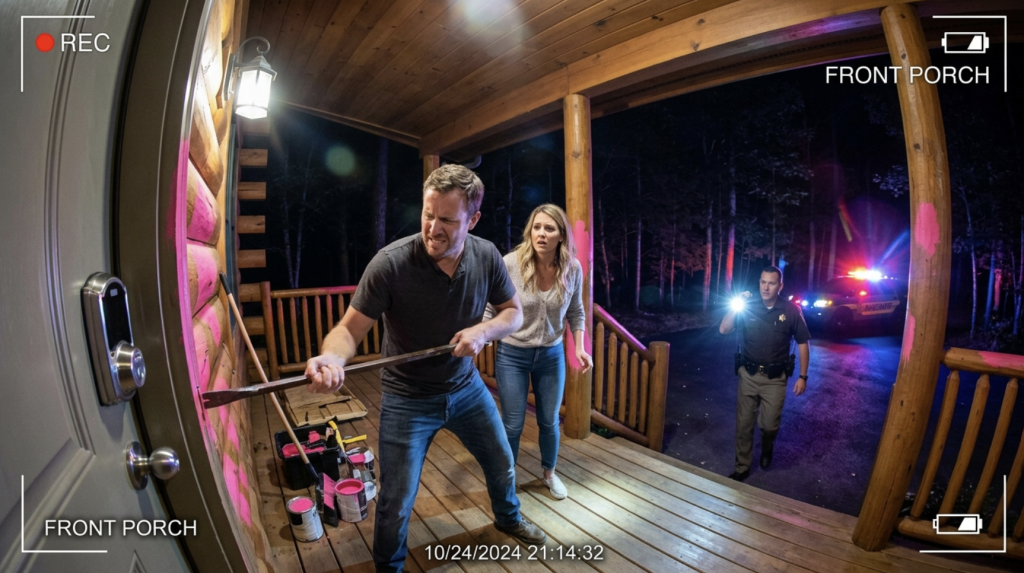
The pink paint was still there.
Someone had tried to scrub a small patch near the window, leaving the cedar surface uneven and stained.
I touched the wall with my fingertips.
I had imagined spending my retirement sitting on that porch with a book, listening to the waves lap against the shore. I had pictured Walt beside me, his old coffee mug resting on the railing while he complained about the weather and asked whether I wanted to go fishing.
I knew those days could never come back.
But the porch had been a way of keeping a little piece of our dream alive.
Now even that seemed to have been taken from me.
I put down the flowers, unlocked the front door, and stepped inside.
At first, everything looked normal.
The kitchen was clean. The living room furniture was where I had left it. The curtains were still hanging beside the windows.
Then I noticed the desk in the bedroom.
Its bottom drawer was open.
I was certain I had closed it before leaving.
Inside were old photographs, several instruction manuals, and a stack of envelopes tied together with string. Someone had moved them around.
I knelt and began examining the contents.
There were photographs of Walt and me on our wedding day, letters from the hospital where I had worked, and an old notebook in Walt’s handwriting.
I almost put everything back.
Then I saw a small brown envelope beneath the notebook.
My name was written across the front.
Not my name in my handwriting.
Walt’s.
My hands went cold.
I recognized the distinctive slant of his letters. He had always written my name with the D slightly larger than the rest, as though he wanted the first letter to stand proudly on its own.
I hadn’t seen that handwriting in four years.
For a moment, I simply held the envelope.
Then I opened it.
Inside was a letter dated three months before Walt died.
Dorothy,
If you’re reading this, I probably didn’t get the chance to tell you everything I wanted to say.
There are things about Brian’s finances that have been troubling me. I don’t know whether I’m worrying too much, but I have seen documents that don’t make sense, and I don’t want you to be caught in the middle of something you don’t understand.
Please look through the blue folder in the back of this desk. I put copies of what I found there. Don’t sign anything you don’t understand, even if someone tells you it’s for the good of the family.
I hope I’m wrong.
I hope this is nothing.
But if I’m not here, I need you to promise me one thing.
Protect what is yours.
Love always,
Walt
I read the letter three times.
Then I looked toward the back of the desk.
There was a narrow compartment I had never noticed before. I reached behind a loose wooden panel and found a blue folder tucked inside.
My fingers trembled as I pulled it free.
The first page was a bank statement.
The second was a copy of a loan application.
The third was a document listing a property I recognized immediately.
Brian and Tanya’s house.
I sat down on the edge of the bed.
The paperwork appeared to show that Walt had once been asked to guarantee a loan connected to Brian’s property. There were references to unpaid obligations and a financial arrangement I didn’t understand.
But what frightened me most was the final page.
It was a copy of a document that appeared to grant Brian authority over certain financial matters if Walt became incapacitated.
Walt’s name was printed at the bottom.
The signature looked real.
But the date was six weeks after he had entered hospice.
I remembered that period vividly. Walt had been too weak to hold a cup without help. Some days, he struggled to speak for more than a few minutes.
I didn’t know what the document meant or whether it was valid.
I did know one thing.
Walt had been worried enough to hide copies of it.
And Brian had been asking about documents in my desk.
I placed everything back into the folder and called Margaret.
When I finished explaining, she told me not to make any assumptions until she had reviewed the documents.
“Photograph every page,” she said. “Don’t write on anything. Put the originals somewhere secure. I’ll arrange a proper review.”
I followed her instructions.
Then I noticed something else.
The folder contained a handwritten note in Walt’s familiar blue ink.
It was only one sentence.
If Brian ever tries to take the cabin, ask him why he needed my signature after I could no longer give it.
I stared at the words until the room seemed to grow smaller around me.
Walt hadn’t known about the cabin. I had purchased it after his death.
So why had he written that sentence?
Unless he wasn’t talking about the cabin at all.
Unless he had seen something in Brian that I had refused to see.
Outside, a branch scraped against the window.
I turned toward the sound.
A car had pulled into the driveway.
I knew the vehicle before I could see the driver.
Brian’s dark blue SUV.
And this time, Tanya wasn’t with him.
He stepped out carrying a cardboard box.
For a moment, he stood beside the porch and looked at the pink wall.
Then he walked toward the front door and knocked.
“Mom?” he called.
I didn’t answer immediately.
He knocked again.
“Mom, I know you’re in there. We need to talk.”
I looked down at Walt’s letter, then at the blue folder on the bed.
For the first time, I realized that my son might not simply be trying to take my home.
He might be trying to reach something hidden inside it.
And I had just found the first clue.
I put the folder into my bag, walked to the front door, and opened it only far enough to see his face.
Brian looked past me into the house.
“Where’s the blue folder?” he asked.
I felt the blood drain from my face.
He knew exactly what I had found.
And judging by the expression on his face, he had come to make sure I never discovered what was inside.