PART 5
My Parents Threw Me Out at 16 for Getting Pregnant
Then he had been ashamed of the letters he had ignored and the promises he had broken.
And now, he stood before me, still carrying that shame like a weight he didn’t know how to put down.
I took the box.
It was surprisingly light.
“Thank you,” I said.
He nodded.
I got into my car and drove away without looking back.
But this time, I wasn’t running.
I was leaving because I had chosen to.
And for the first time in twenty years, that difference meant everything.
Three days later, I was sitting in my office in Denver when my attorney called.
I had sent him scanned copies of the documents the previous evening, along with instructions to review the trust agreement and determine whether any legal claims remained available.
His voice was serious when I answered.
“I’ve reviewed everything you’ve sent me.”
“And?”
“The trust appears to have been established for your benefit and your child’s benefit. There are also records indicating that your parents received multiple notices about it.”
I closed my eyes.
“So they knew.”
“The documents suggest they were aware of the trust and its terms. However, we’ll need the complete records to determine exactly what happened to the funds and whether anyone breached their legal obligations.”
I stared out at the Denver skyline.
“What do you recommend?”
“First, obtain certified copies of the trust documents, the account statements, and the correspondence from the original attorney. Second, we should contact the current trustee or successor institution to determine the status of the trust. Third, we need to establish whether the assets are still there, were distributed, or were improperly handled.”
I nodded, even though he couldn’t see me.
“Do that.”
“And one more thing,” he added. “You should be prepared for the possibility that recovering the funds may not be straightforward. The records are old, and the applicable deadlines will need careful review.”
“I understand.”
After the call, I sat in silence.
I hadn’t returned to Alabama to collect an inheritance.
I had returned because I needed to stop wondering whether my parents had ever regretted what they did.
Instead, I had discovered something much worse.
They hadn’t simply abandoned me.
They had spent years protecting the story they wanted to tell about themselves.
The respectable couple.
The devoted parents.
The family with no embarrassing secrets.
And in doing so, they had denied me the truth about my grandmother’s final act of love.
I opened my desk drawer and removed the letter she had written.
I had read it so many times over the past three days that I could almost recite it from memory.
You have always been loved, even when the people around you forget how to show it.
I pressed the paper flat on my desk.
Then I did something I had avoided for twenty years.
I called Lily.
She answered on the second ring.
“Hey, Mom! Everything okay?”
I smiled at the sound of her voice.
“Everything’s okay, sweetheart. I just need to talk to you about something.”
There was a pause.
“Is this about Alabama?”
I sat up.
“How did you know?”
“You’ve been acting strange since you came back. And you keep looking at that old picture of Grandma Eleanor.”
Lily had always been observant.
“Yes,” I admitted. “It’s about Alabama.”
“Did you see them?”
I looked down at the letter.
“Yes.”
Another pause.
“How did it go?”
I considered giving her the easy answer.
I could tell her that everything was fine, that I had finally found closure, that the past no longer mattered.
But I had spent too many years believing that silence was the same thing as peace.
So I told her the truth.
I told her about my father, my mother, and Emily.
I told her about the hidden trust.
And I told her that her great-grandmother had left something for us.
Lily listened without interrupting.
When I finished, she was quiet for so long that I worried the call had dropped.
Finally, she spoke.
“Mom?”
“Yes, sweetheart?”
“I wish Grandma Eleanor had been there for you.”
I closed my eyes.
“Me too.”
“And I wish you hadn’t had to go through all of that alone.”
My throat tightened.
“I wish that too.”
Lily took a breath.
“But I’m glad you went back.”
I opened my eyes.
“You are?”
“Yes. Not because of the money. Because now you don’t have to spend the rest of your life wondering whether they ever knew what they did.”
I felt tears slide down my cheeks.
My daughter had always possessed a wisdom that made me forget how young she was.
Then she asked, “Can I see the letter?”
“Of course.”
“I want to know who she was. I want to know the woman who tried to help you when nobody else did.”
I smiled through my tears.
“I’ll bring it when I visit.”
“Good.”
Then Lily added, with the gentle certainty that had carried me through more difficult days than she would ever know, “And Mom?”
“Yes?”
“You don’t owe them forgiveness just because they finally feel sorry.”
I looked out at the city.
For twenty years, I had believed that returning home would require me to choose between two impossible things.
Either I would forgive my parents and pretend the past hadn’t happened, or I would refuse to forgive them and spend the rest of my life carrying anger.
But Lily reminded me that there was another possibility.
I could acknowledge what had happened without allowing it to define me.
I could seek the truth without sacrificing my peace.
And I could leave the door open to change without promising anyone that I would walk through it.
“Thank you, sweetheart,” I whispered.
After we hung up, I placed my grandmother’s letter inside a protective sleeve and returned it to the box.
Then I called my attorney again.
There was work to do.
And this time, I wasn’t afraid of what the truth might reveal.
Because whatever happened next, I was no longer that sixteen-year-old girl standing alone in the rain.
I was a woman who had survived.
A mother who had raised a daughter with love.
And a granddaughter who had finally discovered that someone had believed in her all along.
But I still had no idea that the most painful secret in my parents’ house had not been the money.
It was the reason my grandmother had insisted that I receive it.
And when that truth finally came to light, it would change everything I thought I knew about the night they threw me away.
PART 4
Two weeks later, my attorney called with news that changed everything.
The original trust records had been found.
My grandmother hadn’t simply left me money. She had established the trust because she knew my parents might turn their backs on me if I became pregnant. She had even written a letter to her attorney explaining that she wanted me and my child to have a future that no one could take away.
But the most heartbreaking discovery was a letter my grandmother had written shortly before she died.
In it, she explained that she had begged my parents to bring me home after I gave birth.
They had refused.
And when she threatened to seek legal help to ensure I received my inheritance, my father promised he would contact me himself.
He never did.
The attorney confirmed that the records raised serious questions about how the trust had been handled. My legal team began pursuing the matter, determined to establish what had happened to the money and whether any recovery was possible.
For the first time, I had the truth—not the excuses my parents had offered, but the evidence of the choices they had made.
A month later, I returned to Alabama.
This time, I brought Lily.
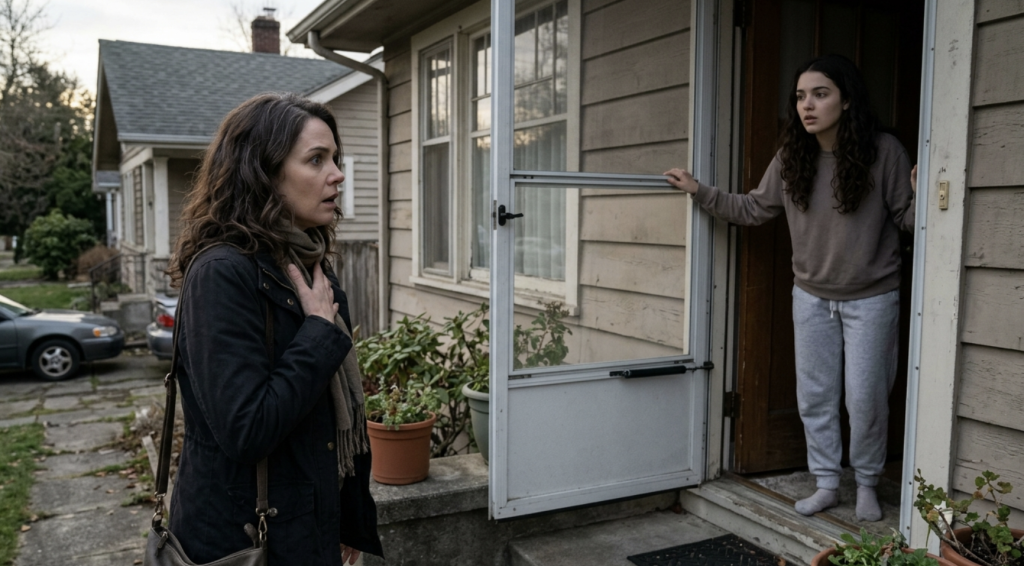
When Emily opened the door, she stared at my daughter in amazement.
“You must be Lily.”
Lily smiled. “And you must be Emily.”
They looked at each other, two young women who had grown up on opposite sides of the same family secret.
Then Emily surprised us both by hugging Lily.
“I’m sorry,” she whispered. “I didn’t know.”
Lily gently hugged her back.
“You don’t have anything to apologize for.”
Inside, my parents waited in the living room.
My father stood when we entered. His eyes moved toward Lily, and tears immediately filled them.
“You’re my granddaughter,” he whispered.
Lily looked at him calmly.
“Biologically, yes.”
His face fell.
“But you haven’t been my grandfather,” she continued. “You don’t get to claim a relationship that you never tried to build.”
My mother began crying.
“We know we can’t undo what happened,” she said. “We were wrong, and we’re sorry.”
I studied their faces.
For twenty years, I had dreamed of hearing those words. I had imagined that an apology would somehow repair the little girl inside me who had waited in the rain for someone to open the door.
But the little girl was gone.
I could finally grieve for her without needing my parents to make everything right.
“I hope you learn to be better people,” I told them. “But forgiveness doesn’t mean we go back to being the family we were. That family ended the night you threw me out.”
My father nodded through his tears.
“I understand.”
For once, I believed he might.
Before we left, Emily asked if she could keep in touch with us.
I looked at Lily, letting her decide for herself.
She smiled at Emily.
“Yes. I’d like that.”
And so, a new relationship began—not because we shared the same blood, but because we chose to treat each other with the kindness our family had once denied us.
Months later, the legal process surrounding my grandmother’s trust reached a resolution. My attorney helped establish what remained of the assets and pursue the recovery available under the law. Whatever the final financial outcome, I knew the most important thing my grandmother had left me was never the money.
It was the knowledge that someone had believed I deserved a future.
I used part of my own resources to expand my company’s program supporting young mothers who had been abandoned by their families. We helped women find housing, finish their education, and build businesses of their own.
At the opening ceremony, Lily stood beside me as I cut the ribbon.
I looked out at the women gathered in the room and remembered the frightened sixteen-year-old who had once believed her life was over because two people had stopped loving her.
If I could speak to that girl now, I would tell her something I wish someone had told me then.
You are not ruined. You are not shameful. And the people who abandon you do not get to decide what your life becomes.
Years later, I returned to my grandmother’s grave with Lily.
I placed fresh flowers beside her headstone and unfolded the letter one final time.
“Thank you,” I whispered. “You believed in me before I knew how to believe in myself.”
The wind moved gently through the trees.
For the first time, I didn’t cry because of what I had lost.
I cried because of everything I had survived.
I never returned to my parents’ house to beg for love again. I didn’t need their approval to prove I was worthy, and I didn’t need their regret to validate my pain.
I had built a life filled with love, raised a daughter who understood compassion, and learned that family was not simply the people who brought you into the world.
Family was the people who refused to let you face the storm alone.
And although my parents had once thrown me out into the rain, they had never been able to destroy the future I built beyond their door.
That future belonged to me.
And at last, so did my peace.